How to use a job description template to create an effective hiring strategy

TL;DR
- Most job descriptions are recycled documents dressed up as hiring tools. Put simply, they attract candidates but fail to support the hiring process that follows.
- A job ad and a job description are not the same thing. Conflating the two will create problems for your organisation, from candidate sourcing to employee onboarding.
- An effective job description template gives you a strong foundation for competency selection, structured interviews, and hiring decisions that push your company forward.
Most job descriptions don’t do what you think
How do you create job descriptions for open roles? If you’re like most hiring managers, the answer is, “I use the JD from last quarter, tweak it for accuracy, and send it to advertising.“
Here’s the problem: The job description you tweaked wasn’t built with intention. It was written in a hurry, or copied from a competitor, and includes outdated company objectives, job responsibilities, and salary ranges. Worse, it’s supposed to double as a job ad and a hiring plan.
An effective job description is neither of these things. The goal of writing a job ad is to attract candidates. The goal of writing a hiring plan is to align your recruitment strategy with company goals. The goal of writing job descriptions is to inform a structured, competency-based interview.
When a JD doubles as both a job ad and a hiring plan, it fails at both. Interview questions become improvised. Scoring becomes inconsistent. And new hires arrive with misaligned expectations that nobody caught before.
The difference between a job description and a job ad
Job descriptions and job ads are two different things. Treating them as the same document is a common mistake that many recruiters make. Here are the main differences:
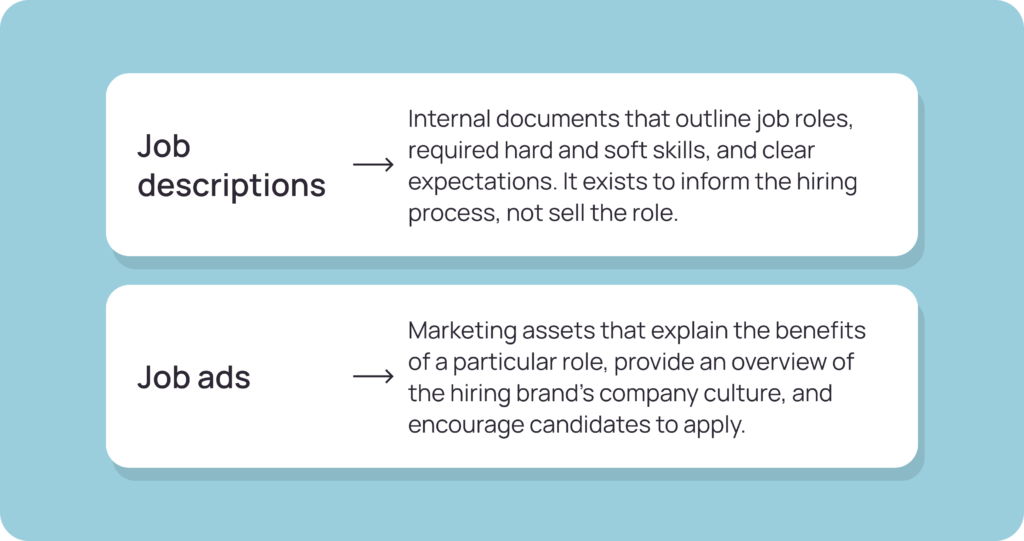
- Job descriptions: Internal documents that outline job roles, required hard and soft skills, and clear expectations. It exists to inform the hiring process, not sell the role.
- Job ads: Marketing assets that explain the benefits of a particular role, provide an overview of the hiring brand’s company culture, and encourage candidates to apply.
Most teams only create the job ad. Unfortunately, this asset doesn’t contain enough detail to drive a structured, competency-based interview, which leads to poor hiring decisions.
What a job description template actually needs to contain
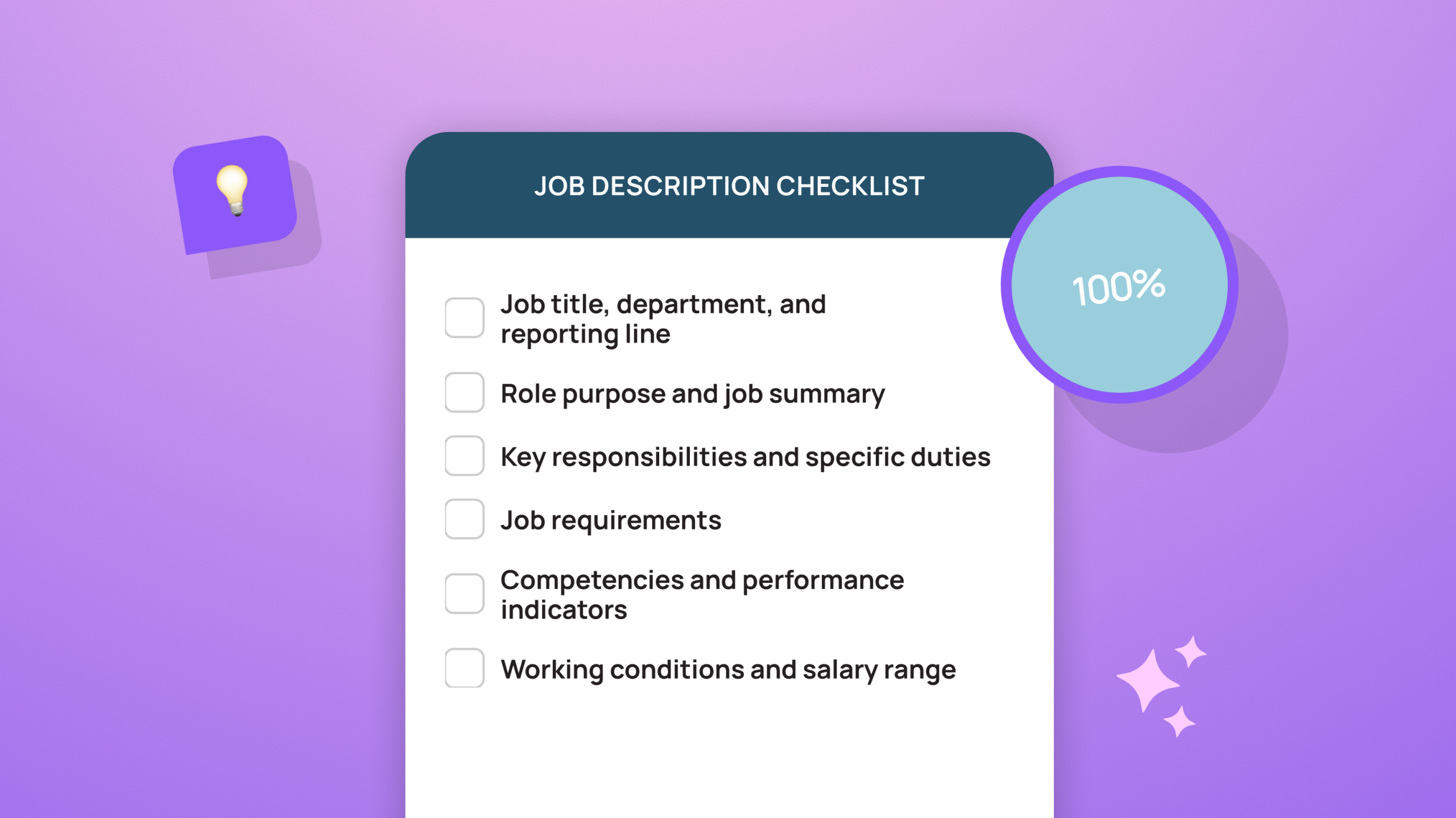
Here is a job description template for you to use for both low and high-volume hiring:

Job title, department, and reporting line
Your job title should be specific. For example, “Outbound Sales Rep” is better than “Lead Door Knocker” because it’s clear. Potential candidates know exactly what an outbound sales rep is.
After you write a clear job title, specify the department and a direct reporting line for the role. This context helps hiring managers align on scope and candidates evaluate fit.
Role purpose and job summary
Write a two to three-sentence job summary that answers one question: Why does this role exist? By explaining the professional value the position creates for the business, you anchor everything that follows. As such, the job summary is a key element of the job description.
Key responsibilities and specific duties
Next, list 6 to 10 responsibilities in order of priority.
Be specific about what the person will spend their time on. Vague entries like “support the team with various tasks” say nothing. If a duty is part of the role, it deserves a proper description.
Job requirements: qualifications, experience, and necessary skills
At which point in the candidate’s professional development are you willing to hire them? Listing required qualifications, experience levels, and skill sets gives candidates the answer.
Remember to separate essential qualifications from desirable ones. Also, be careful when listing degree requirements. In many cases, demonstrable experience is equally valid. Requiring a specific degree—unless there are legal ramifications—could cost you in the long run.
Competencies and performance indicators
A competency-based job description goes beyond tasks and qualifications. It defines the behaviours of high performers: communication, problem-solving, leadership, etc.
In addition, add performance indicators to explain what success looks like at 3, 6, and 12 months. Doing so sets clear expectations from the beginning of your relationship with new hires.
Working conditions and salary range
Finally, include the geographical location of the role, as well as planned working patterns, travel requirements, and, if necessary, physical requirements relevant to the position.
If you’re hiring in the US or UK, include a salary range and benefits information, too. Candidates in many industries want to know about compensation before completing an application.
What to leave out of your job description
Knowing what to cut is just as important as knowing what to include.
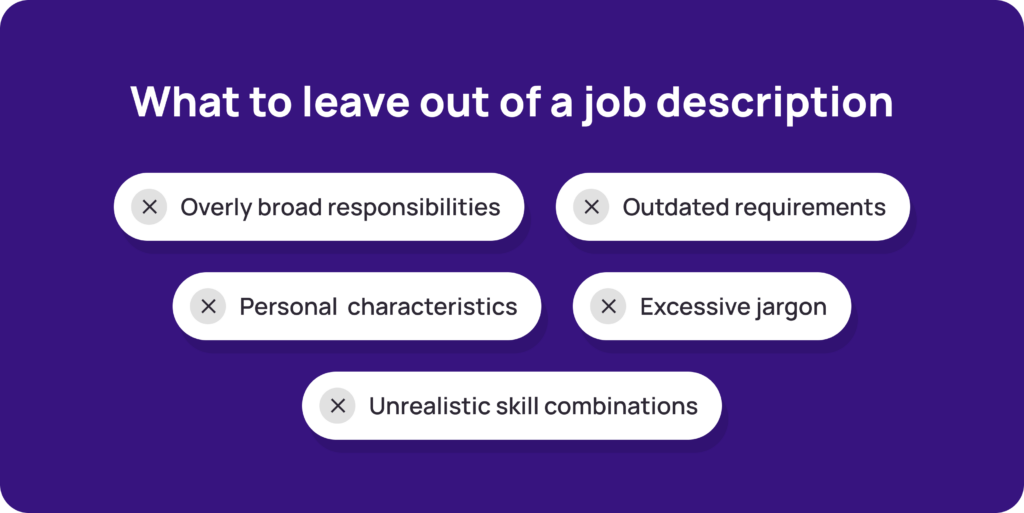
- Overly broad responsibilities. If a responsibility could appear in any job description across your company, it doesn’t need to be there.
- Outdated requirements. Roles evolve. Review each requirement against the current version of the role, not the version that existed when you last hired.
- Personal characteristics. Phrases like “a team player” are too vague to be useful and introduce unconscious bias. Replace them with specific, observable competencies.
- Unrealistic skill combinations. Expecting someone to be a strategic leader and a hands-on executor tells candidates that the employer hasn’t thought through the role.
- Excessive jargon. Internal terminology and acronyms can exclude strong candidates who are unfamiliar with your organisation’s vocabulary. If people outside your company can’t understand a line in your job description, rewrite it so they can.
Here’s a useful test: Give your finished job description to someone outside your team and ask if they understand the role requirements and expectations. If the answer is no, the JD needs work.
The downstream impact of a great job description
A thorough job description shapes the quality of your hiring decisions.
When you define clear competencies, selecting the right interview questions is straightforward. When you’re specific about key requirements, scoring candidates is easier. And when you understand the role’s purpose, hiring teams stay aligned throughout the recruitment process.
Tools like Sapia.ai work with strong JDs to produce weighted competency models that define brilliant candidates for every role. From there, a structured AI chat interview measures the defined competencies. That way, interviewers don’t rely on improvised questions and inconsistent evaluations. This is a surefire way to introduce bias into your hiring workflows.
The result is a better hiring process that produces higher-quality candidates in less time. Book a free demo of Sapia.ai today to see our industry-leading platform in action.
FAQs about job description best practices
A job description template should include the job title, department, reporting line, role purpose, key responsibilities, essential and desirable qualifications, required experience, competencies, performance indicators, and working conditions. The more specific each section is, the more useful the document will be throughout the entire hiring process.
A job description outlines the responsibilities and context of a role. A job specification focuses on the qualifications, experience, and competencies a person needs to perform the job. A job description and job specification template combine both into a single document.
Most effective job descriptions run between one and two pages. This length is long enough to clarify the role and its requirements, but short enough for hiring managers to use. If yours runs longer, look to remove redundant responsibilities or vague requirements.
Writing inclusive job descriptions means auditing your language for gendered or culturally specific terms, removing requirements that are not necessary, and framing competencies around observable behaviours. Tools that analyse job description language for bias can help surface issues that are easy to miss when you’re so close to the content.
A templated job description gives you a consistent structure, but the content should always be role-specific. Using the same responsibilities and requirements across different positions is one of the most common mistakes hiring teams make when creating JDs.
About Author