AI candidate screening: what the evidence actually shows


TL;DR
AI candidate screening is the automated, criteria-based evaluation of applicants — using structured prompts, rules and AI models — to decide who progresses in the hiring process.
But it is not one technology. It ranges from keyword filters reading a resume to structured interviews scored against job-relevant rubrics, and the gap between them is enormous: on the latest meta-analytic estimates, structured interviews predict job performance more than twice as well as unstructured ones, while years of experience — the thing a resume conveys most clearly — predicts almost nothing. That difference also sets your legal exposure.
Everything below turns on one distinction: whether your screening infers fit from data the candidate produced for another purpose, or measures it from a response they produced for this one.
The tension nobody in high-volume hiring can avoid
If you hire at volume — retail, contact centre, healthcare, graduate intakes — the arithmetic is brutal. Woolworths Group receives roughly a million job applications a year for about 40,000 roles. No human team reads that. Something has to triage, and the shift to AI recruiting — screening candidates before a human opens an application — is now near-universal.
The problem is that the methods which triage fastest have the weakest evidence behind them and the most exposure under active bias-audit law. AI resume screening is cheap, instant and easy to bolt onto an ATS. It is also scoring a document the candidate wrote to be scored, on signals a century of selection research says barely predict anything, in a year when a US federal court has allowed discrimination claims to proceed against the software vendor itself.
So: how the methods differ, what the evidence says about each, and how to evaluate whatever you are using or being sold. Sapia.ai has a position here — we run structured, independently bias-audited chat interviews, over 10 million of them across 77 countries — and we state it at the end rather than smuggling it through the middle.
What AI candidate screening actually is
AI candidate screening is the automated, criteria-based evaluation of candidates using structured prompts, rules and artificial intelligence models to determine who should progress in the hiring process. It sits at the top of the recruitment process, between job posting and shortlist, and replaces or augments what a recruiting team would otherwise do by hand: resume review, screening calls, and the first pass of candidate evaluation. The machinery underneath ranges from rules inside an applicant tracking system to machine learning models trained on historical hiring data.
That covers wildly different systems. Any candidate screening AI can be sorted with one question, and that question is the framework the rest of this article rests on: where does the signal come from?
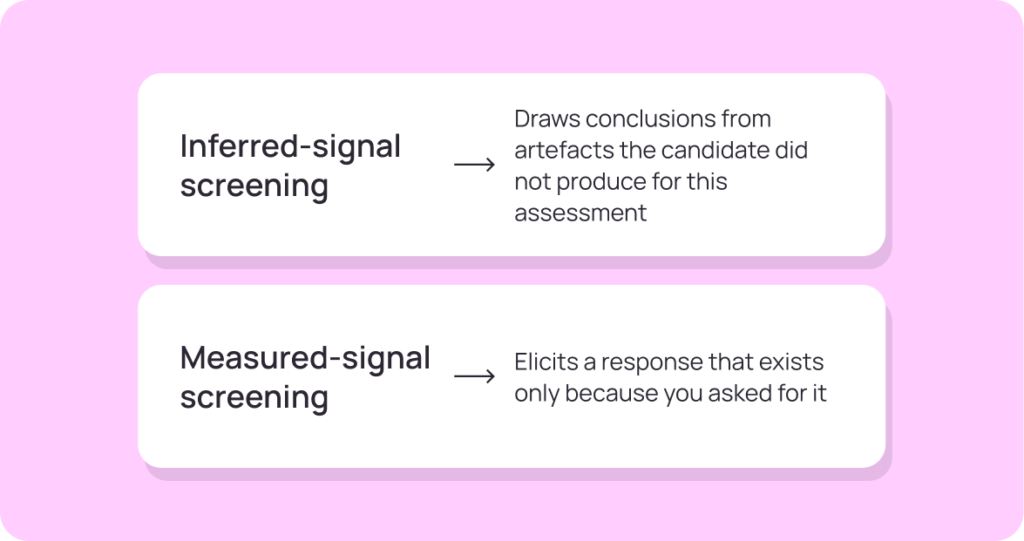
Inferred-signal screening draws conclusions from artefacts the candidate did not produce for this assessment: a CV written for a different job, a LinkedIn profile written for networking, application history, keyword overlap, employment gaps, university name. This is what resume parsing, Boolean filtering, “AI matching” and AI-powered resume screening all do, however sophisticated the AI algorithms underneath.
Measured-signal screening elicits a response that exists only because you asked for it — a structured interview, a work sample, a virtual job simulation, a skills test. Candidate responses are then scored against hiring criteria set in advance for that role, whether what matters is soft skills, technical skills or both.
The distinction matters because inferred signal is a proxy for a proxy — a self-authored marketing document standing in for capability — while measured signal is a small, imperfect sample of the work itself. The two also fail differently. Inferred-signal systems inherit whatever demographic patterns sit in resumes, career history and the training data. Measured-signal systems can be wrong too, but wrong in ways you can inspect, rubric by rubric — the practical case for structured over unstructured assessment.
There is a second consequence. Inferred-signal screening can only surface what a resume already advertises, which quietly penalises people with non-traditional career paths, career breaks, or transferable skills earned outside a matching job title. Measured signal asks everyone the same questions and scores the answers — which is how you widen an inclusive talent pool without lowering the bar, by finding qualified candidates the document sift would have discarded.
| Method | Mechanism | What the candidate does | Data type | Validity and bias considerations |
| Keyword / Boolean filtering | Rules match terms in a document to a requisition | Submits a general-purpose resume | Inferred | No predictive evidence for the rule; rewards resume-optimisation literacy; proxies (school, employer, gaps) track demographics |
| AI resume screening and scoring | Model extracts and ranks attributes from unstructured text | Submits a resume | Inferred | Benchmarked against past decisions; opaque criteria; highly gameable, including by prompt injection |
| Structured chat or video interview | Job-relevant questions scored against fixed rubrics — behaviour, not just keywords | Produces new, role-specific responses | Measured | Highest validity of the common methods (.42); auditable per question; video variants add contested inferences text-based ones don’t |
| Work sample, skills test or virtual job simulation | Candidate performs a representative task; output scored | Performs the task | Measured | Strong validity (.33) and high face validity; costlier per applicant, so usually sits below the top of the funnel |
Where does any given “AI-powered candidate screening” tool sit? Wherever its input comes from. A large language model reading a resume is still resume screening — a better reader of a weak signal, not a better signal. That is the most common category error in the market right now.
What the evidence actually shows
The methods are not equivalent, and the gaps are large
Personnel selection has close to a century of meta-analytic research behind it. The canonical reference was Schmidt and Hunter’s 1998 synthesis; the best current estimates come from Sackett and colleagues (2022), who found earlier figures inflated by overcorrection for range restriction and revised most of them down. Plan against the revised numbers:
| Predictor | Sackett et al. (2022) | Schmidt & Hunter (1998) |
| Structured interviews | .42 | .51 |
| Job knowledge tests | .40 | .48 |
| Empirically keyed biodata | .38 | .35 |
| Work sample tests | .33 | .54 |
| General mental ability tests | .31 | .51 |
| Assessment centres | .29 | .37 |
| Unstructured interviews | .19 | .38 |
| Job experience (years) | .07 | .18 |
Two rows deserve to be read twice. Structured interviews predict job performance more than twice as well as unstructured ones (.42 versus .19). And years of experience — the attribute a resume signals most loudly, and the one keyword filters and human recruiters alike lean on hardest — sits at .07, which is to say approximately nowhere.
This is not an argument about whether AI screens well. It is an argument about what you point it at. Automating a resume sift makes a low-validity process faster, not more accurate — a quicker route to a shortlist, not to quality candidates. Speed applied to a weak signal produces wrong shortlists sooner. It is also why predictive assessment and resume ranking are not interchangeable, however similar the dashboards look.
Adoption has run well ahead of the evidence
Adoption is effectively total. In Insight Global’s AI in Hiring survey of 1,005 US hiring managers at organisations with 100+ employees — fielded October 2024 — 99% reported AI tools somewhere in their hiring process, most commonly for resume screening, scheduling and skills assessment. Greenhouse’s 2026 AI in Hiring Report (November 2025, 4,136 respondents across the US, UK, Ireland and Germany) found 70% of hiring managers trust AI to make faster and better decisions. Add the operational layer that arrived alongside it — AI agents handling outreach, scheduling and messaging to engage candidates — and the screening process is AI end to end.
Read that against the validity table, though: most of it automates inferred signal. The category that scaled fastest is the one with the least evidence behind it.
Candidates have noticed, and trust is falling
The same Greenhouse research found 46% of US job seekers report declining trust in hiring over the past year, 42% blaming AI specifically — rising to 62% among Gen Z. Only 8% describe AI in recruitment as fair, against that 70% of hiring managers, and 87% want employers to disclose when AI is used.
Greenhouse’s follow-up Candidate AI Interview Report (1 May 2026, 2,950 candidates across five markets) sharpened it: 63% have now been interviewed by an AI, up 13 points in six months; 70% were not told beforehand that AI would evaluate them; 38% abandoned a hiring process that included one — promising candidates lost before anyone assessed them. Where completion rate decides whether you fill your reqs, that is not a reputational footnote — it is funnel leakage caused by the screening design itself.
Gaming is now a screening-design problem
This is the genuinely new 2026 risk. In the Greenhouse data, 91% of recruiters and hiring managers have spotted or suspected candidate deception, and 41% of job seekers admitted using prompt injection — hidden text planted in a resume to manipulate the AI reading it — with 52% of the rest considering it.
Prompt injection only works against a system reading a document the candidate controls. So does credential fabrication. The attack surface is a direct function of the method: the more your screening depends on an artefact the candidate submits, the more gameable it is. Structured, interactive assessment is harder to fake at scale — not impossible, but a different problem. Integrity has quietly become an argument for measured signal, independent of validity.
Bias, compliance and legal risk in 2026
NYC Local Law 144: weak enforcement is a warning, not a reprieve
New York City’s Local Law 144 has required annual independent bias audits and candidate notice for automated employment decision tools since July 2023. On 2 December 2025 the New York State Comptroller published an audit of how the Department of Consumer and Worker Protection has actually enforced it, covering July 2023 to June 2025. The findings were damning: DCWP received just two complaints in two years; test calls to the complaint line were routed correctly only 25% of the time; and where DCWP’s review of 32 employer and vendor websites found one likely instance of non-compliance, the Comptroller’s auditors found at least 17 in the same sample.
Read that correctly: it does not mean the law is toothless. It means enforcement has been running well below the actual violation rate, in public view, in a report the city has committed to act on. Penalties run $500–$1,500 per violation, per day. Plan for stricter enforcement, not continued neglect.
The EU AI Act: delayed, not softened
Recruitment and selection systems are high-risk under Annex III of the EU AI Act: conformity assessment, technical documentation, logging, data governance and meaningful human oversight. The Digital Omnibus agreement — reached 6 May 2026, confirmed by Member State representatives on 13 May 2026 — pushed the compliance deadline for stand-alone Annex III systems from 2 August 2026 to 2 December 2027.
Two caveats. Article 50 transparency obligations — telling people when they are interacting with an AI system — stay on the original 2 August 2026 date. And a deferral is not a dilution: the substantive requirements are unchanged, and enterprise procurement cycles routinely run longer than the eighteen months you were just handed.
Mobley v. Workday: the vendor is now in the frame
This is the most consequential development for anyone buying AI-based candidate screening, and why “our vendor handles compliance” is no longer a coherent position for either party.
In Mobley v. Workday (N.D. Cal., No. 3:23-cv-00770-RFL), Judge Rita Lin held in July 2024 that Workday could face direct liability under federal anti-discrimination law as an agent of the employers whose screening it performs, not merely as a software supplier. On 16 May 2025 the court certified a nationwide ADEA collective covering applicants aged 40 and over screened through the platform since September 2020; notice closed 7 March 2026, and the case awaits its first substantive post-certification ruling.
The rest of the map is filling in around it. Illinois’ HB 3773 took effect 1 January 2026, requiring notice whenever AI is used in employment decisions. California’s FEHA regulations on automated-decision systems took effect 1 October 2025, extending record retention to four years — your candidate data stays discoverable that long. Colorado’s SB 26-189, signed 14 May 2026 and effective 1 January 2027, adds notice, adverse-decision disclosure within 30 days and a right to human review.
Strip out the jurisdictional detail and these regimes converge on four demands, which are also the operating principles of defensible screening:
- Job-related criteria only. If you cannot state why a criterion predicts performance in this role, it is both bad selection and an unexplainable adverse decision. Build hiring criteria from the job requirements, not from the job descriptions of people you happened to hire before.
- A blind first pass. Remove name, photo, age, address and education prestige from the first cut. Blind screening strips the cues that trigger unconscious bias in human reviewers and denies a model the proxies it would otherwise learn — the cheapest adverse-impact reduction available, and the one with the clearest read-through to diversity outcomes.
- No third-party data. Scraping social profiles adds no validated signal and creates GDPR and Article 50 problems you do not need.
- Transparency by default. 87% of candidates want disclosure, and several jurisdictions now require it. Tell them what is assessing them, on what criteria, and how to request a human review.
How to evaluate — and roll out — AI candidate screening
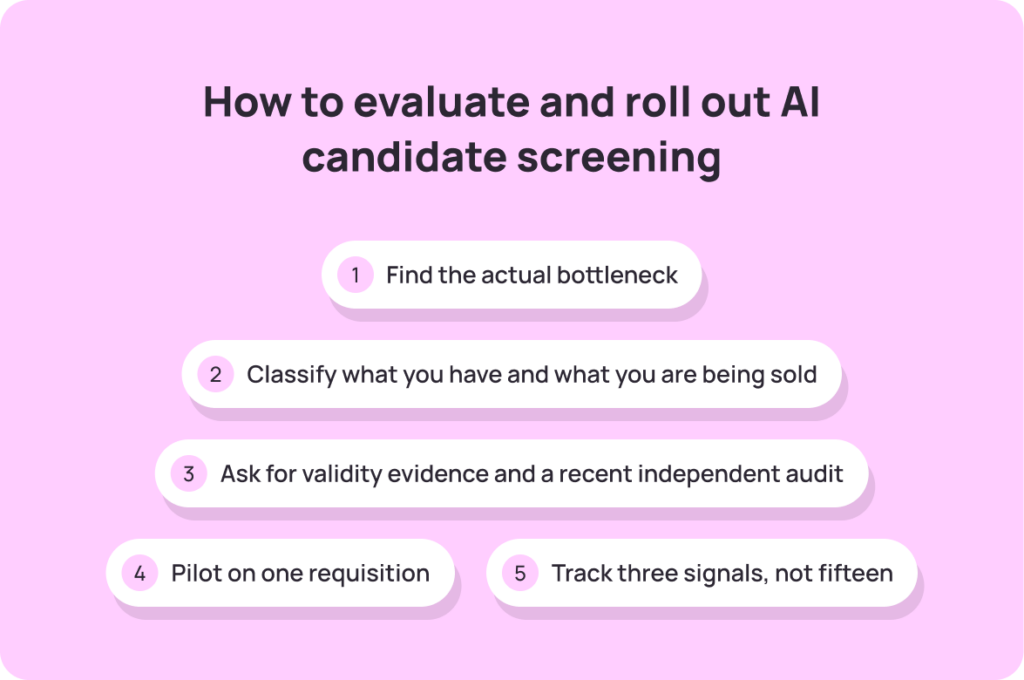
Five steps, in order. Most failed deployments skip the first two, then blame the tool.
1. Find the actual bottleneck
Time to hire, recruiter hours per hire, completion rate, quality-of-hire and early attrition bottleneck at different points, and efficient candidate screening with AI means fixing the one you actually have. If the constraint is a 40% drop-off between application and first contact, a tool that ranks resumes faster solves nothing — start from your candidate evaluation data, not the vendor’s demo.
2. Classify what you have and what you are being sold
Apply the inferred-versus-measured test to all the AI-powered tools in your stack, including the ones already there — our breakdown of the screening tool landscape sorts the main platforms this way. Ask the vendor: what does the candidate produce, and what exactly is scored against which relevant skills? If the answer is “their resume, with an LLM”, you are buying a faster version of a .07-to-.19 process.
3. Ask for validity evidence and a recent independent audit
Content validity (“our experts agree the questions are job-relevant”) is table stakes, not evidence. Ask for criterion-related validity against real outcomes — the predictive analytics linking a score to performance and retention, not a throughput dashboard — plus adverse-impact ratios by protected group, and who ran the audit, when, and over how many tests. A vendor who cannot produce a recent bias audit is telling you something, as is one whose audit covers only the jurisdictions that compel it.
4. Pilot on one requisition
One role, one region, one hiring manager, run in parallel with your existing process long enough to compare shortlists — not a phased twelve-week rollout with a change-management workstream attached. If the shortlisted candidates differ from your recruiters’ picks in ways nobody can explain, stop.
5. Track three signals, not fifteen
Completion rate (does the method survive contact with real candidates?), adverse-impact ratio by protected group (is it selecting fairly?), and candidate experience score (what is it doing to your brand?). Quality-of-hire and retention follow at 6–12 months and are what ultimately validate the decision. And keep human judgment where it earns its keep — on final hiring decisions, not on re-reading job applications the system has already scored.
Where Sapia.ai fits — and where it doesn’t
Sapia.ai‘s Chat Interview is a measured-signal method at the top of the funnel. Every applicant answers five role-specific questions in a text-based, untimed, mobile-first conversation, scored against rubrics built by organisational psychologists for that role — the same criteria for the first application and the ten-thousandth — with the evidence behind each score shown in the candidate’s own words. Hiring teams get a ranked list of top candidates with that evidence attached, not a black-box number. No video, no facial analysis, no voice inference. It replaces resume triage rather than accelerating it — which is the whole point of the argument above.
Two pieces of evidence rather than a wall of them. At Woolworths, the Chat Interview ran at an 82.6% completion rate and supported roughly 27,000 hires in under 10 weeks (case study). On fairness, an independent audit by BLDS, LLC — a statistics and economics firm, not an internal review — ran 72 statistical tests across protected groups in the US and Canada (23 standardised mean difference, 49 adverse impact ratio) and found no evidence of practically significant disparate impact for any group assessed.
As Michael Eizenberg, Group Global Head of Talent Acquisition at Qantas Group, put it: “Sapia.ai has been transformational. We now deliver on our promise to give everyone a fair shot.”
What it is not: a resume-parsing or ATS keyword tool — if that is what you need, this is the wrong product. Nor is it built for deep technical assessment, where a work sample beats a conversation and you should use one. And it does not replace a hiring manager’s judgement further down the funnel. It is built for volume hiring, where the realistic alternative is a human reading 3% of job applications and a filter discarding the rest.
The one thing to take away
Stop asking whether to use AI in candidate screening — the 99% adoption figure settled that. Ask what your screening measures. Inferred signal, however sophisticated the AI technology reading it, is a proxy for a proxy: weakly predictive, structurally gameable, hard to defend when a regulator or a plaintiff asks how a decision was made. Measured signal is more predictive, auditable and harder to fake.
Good AI-powered candidate screening in 2026 looks like this: every candidate assessed against the same objective criteria, scores explainable in the candidate’s own words, an independent bias audit you can hand to your general counsel, and disclosure the candidate reads before starting. If your process can’t produce all four, that is your roadmap. Book a demo if you want to see what measured signal looks like on one of your own requisitions.
Sources
- Sackett, Zhang, Berry & Lievens (2023), Table 1 — https://www.cambridge.org/core/journals/industrial-and-organizational-psychology/article/revisiting-the-design-of-selection-systems-in-light-of-new-findings-regarding-the-validity-of-widely-used-predictors/A20984B138319E3D432E643978BF026D
- NY State Comptroller audit, 2 December 2025 — https://www.osc.ny.gov/state-agencies/audits/2025/12/02/enforcement-local-law-144-automated-employment-decision-tools
- Greenhouse 2026 AI in Hiring Report — https://www.greenhouse.com/guidance/the-2026-ai-in-hiring-report
- Greenhouse 2026 Candidate AI Interview Report — https://www.greenhouse.com/newsroom/63-of-job-seekers-have-faced-an-ai-interview-most-havent-had-a-good-one-yet
- Insight Global AI in Hiring survey — https://insightglobal.com/2025-ai-in-hiring-report/
- Mobley v. Workday docket tracker — https://ailawsuittracker.com/cases/mobley-v-workday-3-23-cv-00770-rfl/
- EU AI Act Digital Omnibus — https://www.gibsondunn.com/eu-ai-act-omnibus-agreement-postponed-high-risk-deadlines-and-other-key-changes/
- Colorado SB 26-189 — https://www.crowell.com/en/insights/client-alerts/colorado-hits-reset-on-ai-regulation-sb-26-189-repeals-and-reenacts-the-colorado-ai-act
- Illinois HB 3773 / California FEHA — https://www.seyfarth.com/news-insights/artificial-intelligence-legal-roundup-colorado-postpones-implementation-of-ai-law-as-california-finalizes-new-employment-discrimination-regulations-and-illinois-disclosure-law-set-to-take-effect.html
- Sapia bias audit — https://sapia.ai/sapia-ai-recruitment-software/sapia-releases-its-independent-bias-audit/
FAQs about AI candidate screening
AI candidate screening is the automated, criteria-based evaluation of applicants using structured prompts, rules and AI models to decide who progresses. It spans keyword filters and resume scoring at one end and structured interviews and work samples at the other — methods with very different accuracy and risk profiles.
Yes to both. It is lawful, but increasingly regulated. NYC Local Law 144 requires annual bias audits and notice; Illinois requires disclosure from January 2026; California’s FEHA rules apply discrimination law to automated systems; and the EU AI Act classifies recruitment AI as high-risk, with Annex III obligations due 2 December 2027.
Either, depending on the method. Systems inferring fit from resumes and career history can inherit historical hiring patterns and scale them. Structured, blind, rubric-scored assessment applies consistent evaluation criteria to every applicant and can be audited for adverse impact — which manual screening, at volume, effectively cannot.
Accuracy comes from the method, not the automation. In Sackett et al. (2022), structured interviews reach .42 operational validity, work samples .33, unstructured interviews .19 and years of experience .07. Automating a resume sift inherits that low ceiling; automating structured assessment inherits a much higher one.
Resume screening infers fit from a document the candidate wrote for general use — an indirect, easily gamed proxy. Interview screening measures a response produced specifically for the role and scores it against fixed rubrics. Same automation, very different signal quality and audit trail.
Some methods, easily. Greenhouse’s 2026 research found 41% of job seekers had used prompt injection — hidden text designed to manipulate AI screening tools — and 91% of recruiters had spotted or suspected deception. Document-based screening is the vulnerable surface; live structured interaction is materially harder to game.
Compare AI candidate screening tools on what the candidate produces and what is scored. Request criterion-related validity evidence, not just content validity; a recent, dated independent bias audit naming the tests and groups covered; disclosure and human-review workflows; and integration with your applicant tracking system. Then pilot on one requisition.
This is where it works best, because the alternative — manual screening of a small fraction of applications — is slower and less accurate. The constraint is completion rate: short, mobile-first, untimed formats keep more candidates in, while long assessments and one-way video shed top talent before you can assess them.
About Author