TL;DR
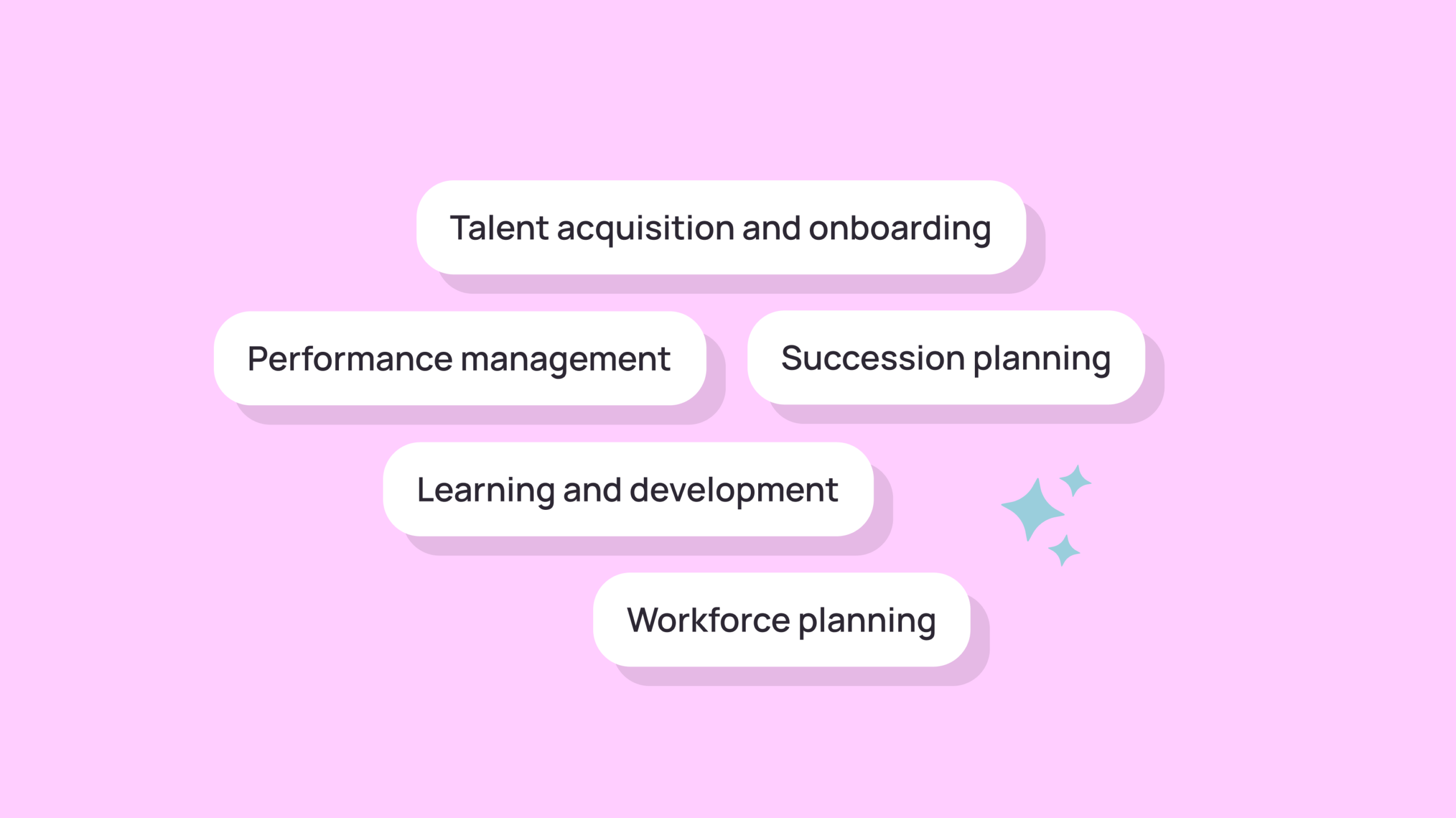
- A talent management system is a platform that supports the entire employee lifecycle, from talent acquisition and onboarding through to performance management, succession planning, and workforce planning.
- Traditional talent management solutions handle admin well but often fail to surface the people insights that drive genuine career growth and talent retention.
- AI-powered talent management brings together performance data, competency profiles, and organisational goals to help HR teams make smarter, faster decisions about their people.
- The most effective modern talent management systems connect hiring data with ongoing employee development, so the insights generated at the point of recruitment continue to add value throughout an employee’s career.
- Sapia.ai‘s platform generates rich competency and personality data from day one of the hiring process, giving organisations a head start on talent strategy that most management systems never get.
What is a talent management system?
A talent management system (TMS) is a suite of HR tools designed to manage the full employee lifecycle. At its core, a talent management system covers the key elements that determine how people join an organisation, how they develop within it, and how the organisation plans for future capability needs. These key elements typically include talent acquisition, employee onboarding, performance management, learning and development, succession planning, and workforce planning, all in one place.

The definition of talent management has evolved considerably in recent years. Earlier systems focused primarily on administrative tasks and managing current processes, such as data administration and compliance. In contrast, modern talent management solutions are expected to do something more substantive: help organisations understand their people deeply, develop them continuously, and make strategic decisions about where talent gaps exist and how to close them.
For HR professionals and HR teams navigating a market characterised by skills shortages, rising workforce expectations, and accelerating digital transformation, a talent management system that delivers genuine insight has moved from a nice-to-have to a business necessity.
How does a talent management system work?
A talent management system works by centralising employee data and connecting it across HR processes that have historically operated in silos. When a new hire joins, their details, competencies, and role requirements flow into the system. As they progress, performance data, feedback from performance reviews, learning activities, and development conversations layer on top of that foundation. Over time, the system builds a progressively richer picture of each person’s strengths, skills gaps, and potential, which HR teams and managers can use to inform decisions about development opportunities, internal mobility, and succession planning.
The practical value of this connected view is significant. Many organisations have useful data about their people scattered across an ATS, a separate learning management system, a spreadsheet-based performance review process, and their HR team’s memory. A modern talent management system brings all of that together so that data-driven decisions about talent become possible, rather than something that happens only when someone thinks to go looking for the relevant information.
What distinguishes an AI-powered talent management system from a conventional one is the ability to surface patterns and insights that human review of raw data would miss. Rather than presenting HR professionals with dashboards full of employee data and leaving the interpretation to them, AI layers on analysis: flagging top performers who are at risk of leaving, identifying internal candidates for open roles whose competency profiles match the requirements, or highlighting teams where skills gaps are likely to become a problem before they do.
Key functions of a modern talent management system
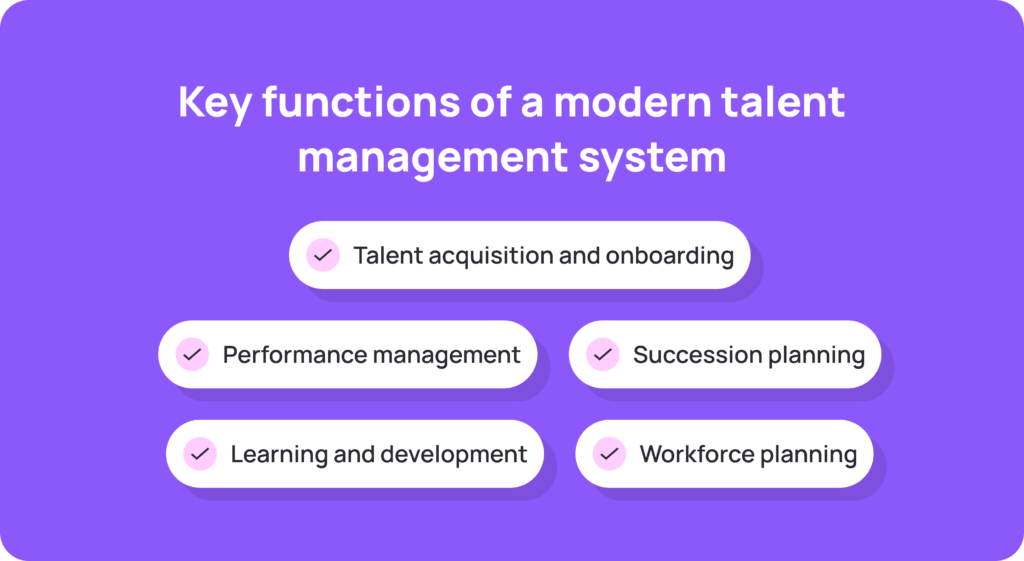
Understanding what a talent management system does in practice requires looking at each stage of the employee lifecycle it supports. The key elements of a talent management system typically include recruitment, onboarding, performance management, learning and development, succession planning, and compensation management. Compensation management, in particular, plays a crucial role in aligning employee rewards with organisational goals and supporting data-driven HR strategies within integrated HR software solutions.
Talent acquisition and onboarding
The talent management lifecycle begins before an employee joins. The quality of the hiring decision shapes everything that follows: who onboards, how quickly they reach full productivity, how long they stay, and how much they contribute. A talent management system that integrates closely with the recruitment process carries insight from candidate assessment directly into the onboarding and development planning that follows.
This is one of the areas where AI-powered recruitment platforms like Sapia.ai create lasting value. The competency and personality profiles generated through Sapia’s Chat Interview do not disappear at the point of hire. They become a baseline for understanding what a new hire brings, where their development opportunities lie, and how to set them up for long-term success from day one.
Performance management
Performance management is a function that most organisations do, but fewer do well. Annual performance reviews that take place once a year, assessed against vague criteria by managers with inconsistent standards, produce data that is neither reliable nor especially useful for strategic planning. A modern talent management system supports ongoing feedback, continuous learning conversations, and performance data that is tied to defined competencies and organisational goals, helping to drive performance and increase employee engagement rather than relying on a manager’s general impression of how someone is doing.
When performance data is structured and consistent, it can be aggregated meaningfully. A talent management system uses this performance data to visualise bench strength, helping organisations prepare for future leadership transitions. HR teams can identify where top performers are concentrated, which roles have the clearest links between competency profiles and performance outcomes, and where individual employees need support or development to reach their potential.
Succession planning
Succession planning is one of the most strategically important and most frequently neglected functions of a talent management system. Many organisations have no formal succession plan for key roles, meaning that when a critical position becomes vacant, the response is reactive rather than prepared. A well-implemented talent management solution makes succession planning systematic by maintaining visibility of internal talent across the workforce and matching employee profiles to future role requirements before the need becomes urgent.
AI adds genuine capability here. By analysing competency data, performance data, and career trajectory patterns, an AI-powered management system can identify which employees are most likely to be ready for senior roles in the near term, where internal talent gaps are likely to emerge, and which development paths will produce the fastest returns for both the individual and the organisation.
Learning and development
A talent management system that supports continuous learning connects each employee’s competency profile and performance data to relevant development tools and learning paths. Rather than offering the same training catalogue to everyone, it can surface learning opportunities that address the specific skills gaps identified in an individual’s profile. This makes development more relevant, more efficient, and more likely to result in genuine capability growth rather than completed compliance training that nobody remembers.
Continuous learning has also become a retention issue. Employees who see clear growth opportunities and who feel their development is actively supported by their organisation stay longer and engage more deeply with their work. A talent management system that makes development opportunities visible and personalised is a direct contributor to employee satisfaction and talent retention.
Workforce planning
At the strategic level, a talent management system gives HR teams and business leaders the data they need for effective workforce planning. By aggregating employee data on competencies, skills gaps, performance trajectories, and attrition risk across the organisation, it enables HR professionals to anticipate future capability needs rather than simply responding to them. This is what makes talent management a genuine strategic initiative rather than an administrative function.
Workforce planning powered by good data helps organisations answer questions that matter to business success: Where will we face skills shortages in the next 12 to 24 months? Which roles are at the highest risk of turnover? Do we have the internal talent to support our growth plans, or do we need to hire externally? Without a connected talent management system, these questions get answered by instinct. With one, they get answered by evidence.
Benefits of a talent management system
Organisations that implement a modern talent management system consistently report benefits across hiring, development, retention, and strategic planning. The key benefits fall into a few interconnected areas.
Better hiring decisions create a stronger foundation for everything else. When the recruitment process generates structured competency data and that data flows directly into the talent management system, HR teams start with a richer understanding of each new hire from day one. That understanding shapes better onboarding, more relevant development planning, and more accurate succession planning over time.
Reduced employee turnover is one of the most financially significant benefits of a well-implemented talent management solution. Talent retention improves when employees feel their growth is supported, when internal talent is genuinely considered for open roles before external candidates are recruited, and when performance management conversations are substantive and ongoing rather than annual and administrative. Each of these outcomes depends on the connected data and tools that a talent management system provides.
Improved decision-making is a benefit that compounds over time. As more employee data flows through the system, patterns emerge that individual managers or HR professionals cannot easily see. Which competencies predict long-term success in specific roles? Which teams are developing skills gaps that will affect performance in six months? Which employees are ready to step into greater responsibility? These are questions that a data-rich talent management system can answer systematically, reducing reliance on anecdote and improving the quality of strategic planning.
How AI is changing talent management
Traditional talent management systems are good at storing and organising employee data. What many of them struggle with is turning that data into action. HR teams often find themselves with access to a great deal of information about their people but limited capacity to analyse it meaningfully or act on it in time to make a difference.
AI changes this by doing the analytical work that human review of large datasets cannot reliably sustain. An AI-powered management system does not just report that attrition is up in a particular team. It identifies the patterns in performance data, engagement scores, and competency profiles that precede attrition, so HR teams can intervene early rather than after the fact. It does not just list available internal candidates for an open role. It matches candidate profiles to role requirements and highlights the best fits based on competency alignment and development trajectory.
Sapia.ai‘s Talent Intelligence Agent (TIA) is built around exactly this capability. TIA synthesises insights across the platform to help recruiters and hiring managers make smarter, faster decisions, acting as a co-pilot for the humans in the loop, surfacing patterns, nudging actions, and ensuring the best of AI and human judgment work together. This is what a modern talent management system should look like: not a passive repository of employee data, but an active intelligence layer that makes that data useful.
The integration between Sapia.ai’s hiring platform and ongoing talent management is also worth noting. The competency profiles generated through Sapia.ai’s Chat Interview, covering traits like analytical thinking, adaptability, accountability, and communication, do not exist in isolation. They become the foundation of a talent profile that HR teams can build on through performance management and development conversations, creating continuity between the hiring decision and the employee’s entire career within the organisation. The Sapia platform is designed to support that continuity from the first interaction.
Choosing the right talent management system
Many organisations find that choosing a talent management system is less about finding the most feature-rich product and more about finding the one that will actually be used. A TMS with hundreds of capabilities that HR teams find difficult to navigate or that managers avoid engaging with will not deliver better outcomes than a simpler system that becomes part of how people actually work.
Once an organisation has defined its talent management needs, the next step is choosing the right technology to support them—ideally, an integrated workforce management platform that offers a unified view of the entire workforce. It’s also crucial to ensure the talent management system aligns with your business objectives so that employee development and HR activities directly support organisational goals.
A few considerations consistently matter most when evaluating talent management solutions:
- Company size should be considered to ensure the system fits your organisational needs and budget, as vendors often tailor offerings and pricing based on this factor.
- Integration with existing systems, including your ATS, payroll systems, and any learning platforms already in use, determines whether the talent management system will have access to the employee data it needs to function effectively.
- User experience for managers and individual employees, not just HR professionals, shapes whether the system gets used for ongoing performance conversations and development planning or whether it becomes another piece of software that people open once a year for performance reviews.
- AI capability should be evaluated in terms of the specific decisions it supports, not just as a feature. Does the system surface actionable insights about succession planning risks, skills gaps, or attrition likelihood? Or does it simply present data and leave the analysis to the user?
- Data security and compliance, particularly around employee data stored in cloud-based systems, should be assessed carefully, especially for organisations operating across multiple jurisdictions with different data privacy requirements.
For organisations thinking about how talent management connects to the recruitment process specifically, the talent intelligence platforms guide and the piece on talent intelligence insights both cover the data and decision-making dimensions in practical detail.
Challenges of implementing a talent management system
Implementing a talent management system is not without difficulty, and organisations that go in with a clear-eyed view of the challenges are better positioned to navigate them.
Integration complexity is consistently one of the biggest practical obstacles. Many organisations run HR processes across multiple systems that were not designed to talk to each other. Connecting an ATS, a learning management system, a performance management tool, and payroll data requires careful planning and usually some degree of custom integration work. The reward is a unified view of employee data, but getting there takes time and resource.
User adoption is the other perennial challenge. HR technology investments frequently underdeliver, not because the technology is poor but because the people who are supposed to use it do not change their behaviour. Managers who have always done performance reviews on paper or in email are unlikely to shift to a structured digital process without training, encouragement, and visible support from senior leadership. Building adoption into the implementation plan from the beginning, rather than treating it as something that will happen naturally, is essential.
Skills gaps in the HR team itself can also limit what a talent management system achieves. Using data-driven insights to inform succession planning or workforce planning requires a level of analytical confidence that not all HR professionals have developed. Investment in training alongside the technology investment is often what separates successful implementations from disappointing ones.
Conclusion
A talent management system done well is one of the most powerful levers available to HR teams and business leaders. By connecting talent acquisition, performance management, succession planning, learning and development, and workforce planning in a single platform, it transforms employee data from an administrative record into a strategic asset.
The shift to AI-powered talent management takes this further. When a management system can surface patterns in performance data, identify succession risks, match internal talent to open roles, and flag skills gaps before they become business problems, it stops being a place to store information and becomes a genuine driver of business success.
For organisations ready to see what that looks like in practice, the starting point is often the hiring process itself. The richer the competency data generated at the point of hire, the more value flows through the talent management system over time. Book a demo with Sapia.ai to see how AI-powered assessment at the top of the funnel creates better foundations for everything that follows.
Frequently asked questions about talent management systems
A talent management system is a platform that supports the full employee lifecycle, covering talent acquisition, onboarding, performance management, learning and development, succession planning, and workforce planning. Its purpose is to centralise employee data and connect it across HR processes so that organisations can make better decisions about their people.
A talent management system works by bringing together employee data from across the organisation and connecting it to the HR processes that shape how people are hired, developed, and retained. As employees progress, their performance data, competency profiles, and development activity accumulate in the system, enabling more informed decisions about individual careers and organisational capability.
The key benefits include better hiring decisions grounded in consistent competency data, improved talent retention through visible development opportunities and meaningful performance conversations, stronger succession planning based on real-time visibility of internal talent, and more effective workforce planning supported by data-driven insights rather than instinct.
AI improves a talent management system by turning large amounts of employee data into actionable insights that human review cannot reliably produce at scale. This includes identifying attrition risks before they materialise, matching internal talent to open roles based on competency alignment, surfacing skills gaps across the workforce, and personalising development paths for individual employees.
An applicant tracking system (ATS) manages the recruitment process, from job postings and candidate applications through to the hiring decision. A talent management system picks up where the ATS leaves off, managing the development, performance, and career progression of employees once they have joined the organisation. The most effective approaches connect the two, so that competency data generated in the hiring process carries forward into ongoing talent management.
About Author