AI Interview scheduling: the 7 best tools for cutting coordination time in 2026

TL;DR
AI interview scheduling is software that uses automation – and increasingly AI agents – to match interviewer and candidate availability, book interviews, and chase confirmations without a human doing it manually. Automated interview scheduling exists because calendar Tetris is one of the few repetitive tasks left in hiring that is entirely mechanical, entirely necessary, and entirely capable of losing you qualified candidates while you do it.
This guide does two things most listicles don’t.
- It applies a fixed six-criterion scorecard to every tool: integration depth, panel complexity, candidate self-service, no-show reduction, verifiable AI, pricing transparency.
- It says plainly which “AI scheduling” tools are actually dedicated scheduling software – and which are a module inside a bigger suite, or basic scheduling tools running calendar-intersection logic behind an AI label.
The seven: GoodTime and ModernLoop for complex panels, candidate.fyi for candidate experience, VidCruiter for global and video-bundled scheduling, Yello for campus and event volume, and Paradox (now a Workday product) and Phenom for suite-level bundling.
Sapia.ai is not a scheduling-software vendor, and this guide doesn’t pretend otherwise. There’s an honest section below on where its scheduling capability fits – and where you should shortlist someone else.
Manual interview scheduling is one of the most time-consuming and error-prone parts of the recruitment process – a back-and-forth of emails that talent acquisition teams run dozens of times a week – and when it drags on it is a leading cause of qualified candidates going quiet. candidate.fyi‘s analysis of roughly 258,000 recruiting coordination signals put the average time to schedule a single interview at 243 minutes of manual effort, against 27 minutes when candidates self-schedule. Greenhouse research it cites found half of candidates have ghosted an employer, a quarter naming slow communication as the reason. Both are vendor-published rather than independently audited – but the direction of travel isn’t in dispute.
The bigger problem for a buyer is category confusion. “AI interview scheduling” now describes purpose-built schedulers with years of panel logic behind them, a scheduling module bolted onto a video-interviewing platform, a conversational scheduling assistant that happens to book time, and agent-building platforms with a recruiting template. These are not the same purchase, and comparing them on one feature grid produces a shortlist that falls apart in procurement.
A note on who’s writing this. Sapia.ai builds human-centric AI for structured chat interviews at volume, and its assessment has been independently audited for disparate impact by BLDS, LLC, which found no evidence of practically significant disparate impact across 23 standardised mean difference tests. That’s the vantage point: we know what hiring volume does to a scheduling process, and we don’t sell a competing scheduler.
How we chose and ranked these tools
Who made the list, and who didn’t
A tool earned a ranked slot if it is genuinely dedicated to – or primarily bought for – AI-assisted interview scheduling automation, with a real market footprint: named enterprise customers, a live product, and independent coverage in verified user reviews on G2 or Capterra.
Four well-known names were excluded on category fit, not quality:
- HireVue bundles scheduling inside video interviewing with no standalone scheduling SKU.
- Willo is an async video tool whose pitch is removing the need to schedule live interviews at all.
- Metaview is interview intelligence, positioned as complementary to a scheduler rather than a substitute.
- Kore.ai sells a configurable agent-building platform with a recruiting template, not a purchasable scheduling product.
Worth watching: Radancy acquired myInterview in September 2025 and now markets screening-and-scheduling agents, but has no independent review coverage as a merged product yet. Prelude was acquired by Calendly in 2022 and its standalone status couldn’t be confirmed, so it’s excluded rather than mischaracterised.
The 6 scoring criteria
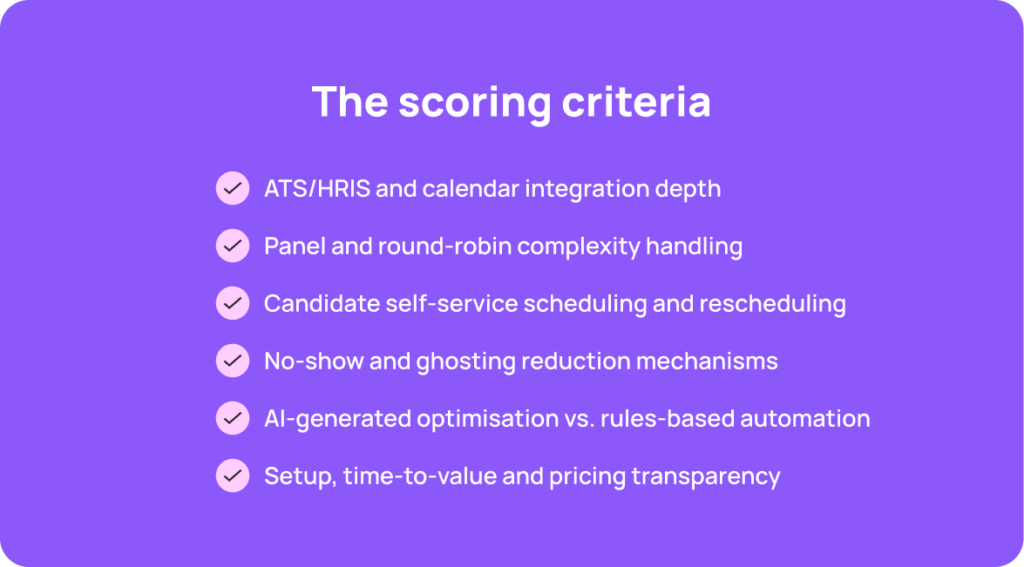
- ATS/HRIS and calendar integration depth. Native two-way sync – not a Zapier bridge – with your actual applicant tracking system (Greenhouse, Workday, Lever, iCIMS, SAP SuccessFactors, Ashby) and the calendar system you use to schedule candidate interviews. Every vendor promises seamless integration; ask for field-level mapping. This is where implementations most often fail.
- Panel and round-robin complexity handling. Can it read hiring team availability across a full panel, resolve scheduling conflicts, auto-replace an interviewer who drops out, and do genuine interviewer load balancing across a pool? Or is it built for 1:1 booking? This is the line between an AI complex interview scheduling software purchase and a calendar link – and it is the criterion that separates real tools from basic scheduling tools once complex scheduling scenarios arrive.
- Candidate self-service scheduling and rescheduling. Branded booking pages that let candidates pick their preferred interview times, one-click links to reschedule or cancel interviews, and whether a candidate needs an ATS login to act.
- No-show and ghosting reduction mechanisms. Timely reminders, nudges for stalled bookings, the candidate engagement touches in between, and whether the vendor publishes a real, attributed outcome number. Treat any vendor’s no-show percentage as a single-customer case study, never a category baseline.
- AI-generated optimisation vs. rules-based automation. Is the agent’s reasoning – interviewer fatigue, skill-tag matching, load balancing – disclosed in verifiable detail, or is it calendar-intersection logic with an AI label? Most AI interview scheduling agents launched in 2025–2026 fall into that gap, and we say so.
- Setup, time-to-value and pricing transparency. Every dedicated vendor here is quote-only – a category-wide pattern worth naming as a finding, not a flaw unique to one vendor.
The 7 best AI interview scheduling tools, by category
There is no single best interview scheduling software. The best AI interview scheduling software is whichever one is built for your specific bottleneck.
| Platform | Category | Best for | Scheduling mechanism | Native integrations | Pricing |
| GoodTime | Multi-panel enterprise | Panel load-balancing at scale | Agent-assisted panel matching, auto-replacement, block scheduling | Greenhouse, Lever, Workday, iCIMS, SAP SuccessFactors, Ashby | Quote-only |
| ModernLoop | Multi-panel enterprise | Certification + scheduling in one | “Zero-Click Scheduling” on ATS stage change; workload-aware selection | ATS integrations; Google & Outlook | Quote-only |
| candidate.fyi | Candidate-experience-first | Branded candidate portals | Two-way ATS sync with self-scheduling portals | Claims 40+ ATS platforms | Quote-only |
| VidCruiter | Global, video-bundled | Multi-timezone hiring | Pre-filters invalid slots; matches full panel first | Broad ATS bench; global timezone handling | Quote-only |
| Yello | Campus and events | Career fairs, super days | Real-time room and calendar conflict detection | Greenhouse (verified); wider bench unconfirmed | Quote-only |
| Paradox (Workday) | Conversational / suite | Frontline, high-volume hiring | SMS-first conversational booking | Workday-native post-acquisition | Quote-only |
| Phenom | Enterprise suite | Teams buying a full suite | 24/7 automation plus Personal Scheduling Links | Microsoft, Google, or Phenom’s calendar | Quote-only |
1. GoodTime – best for panel load-balancing at enterprise scale
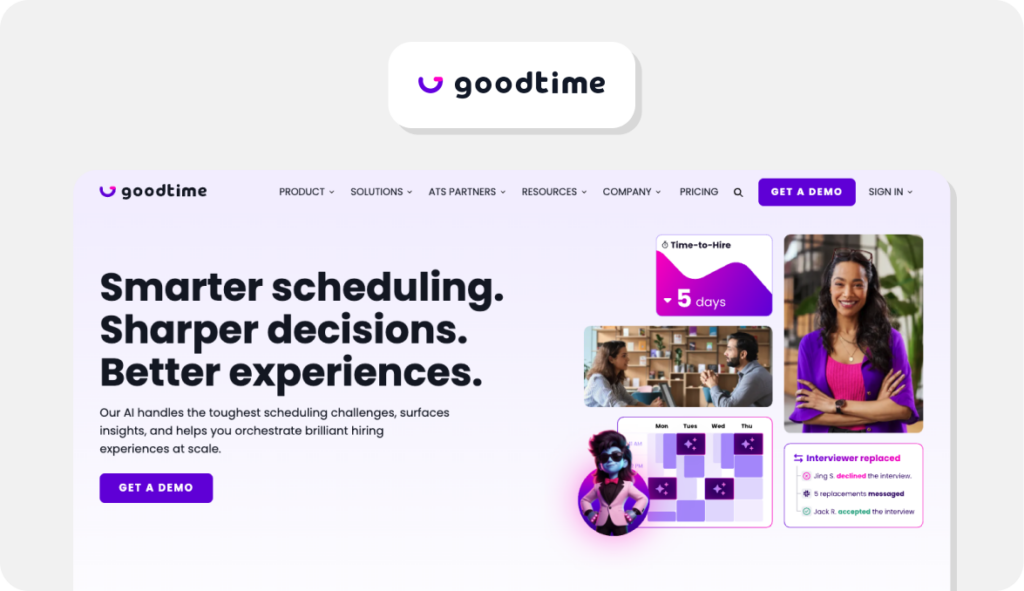
Best for: Enterprise talent teams running high-volume, multi-interviewer loops across regions.
What it does: Matches hiring team availability across a full panel, does true interviewer load balancing across a pool, and replaces an interviewer who becomes unavailable rather than kicking the loop back to a coordinator. Its Orchestra layer and Cori agent handle block and multi-day scheduling plus region- and timezone-specific rules in one framework [criterion 2].
AI vs. rules-based: GoodTime markets Cori as an autonomous agent, but public materials don’t disclose enough detail to confirm genuine LLM reasoning versus a well-marketed rules engine [criterion 5].
Strengths: The broadest verified ATS bench here [criterion 1]. HubSpot’s vendor-published case study reports a 75% increase in hiring team productivity, 30% faster scheduling, and a 152% rise in active interviewers to 1,600 globally [criterion 4].
Where it falls short: Reviewers consistently cite calendar and ATS sync bugs, occasional downtime, and a steep learning curve for new admins. It’s repeatedly flagged as expensive and less accessible for smaller companies.
Pricing: Quote-only [criterion 6].
Verdict: The deepest option here if your bottleneck is genuinely complex workflows across multiple interviews and regions – and you’ll pay for that depth.
2. ModernLoop – best for scheduling plus interviewer certification
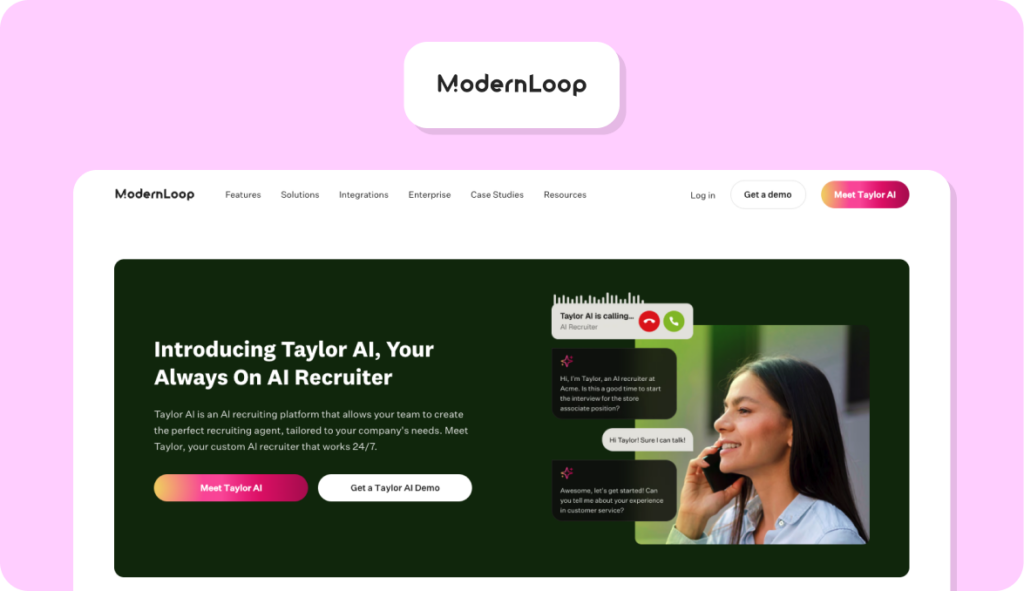
Best for: Scaling companies growing an interviewer pool without losing consistency.
What it does: “Zero-Click Scheduling” fires automatically as candidates move from one interview stage to the next in your ATS, sending requests and candidate communication with no coordinator action – which is where its time-to-schedule gains come from. It compares interviewer load as well as availability when building a panel [criterion 2]. Its interviewer training and certification tracking is the genuinely differentiated feature: you can enforce who is qualified to run which interview, which underpins a consistent candidate experience and structured-hiring compliance.
AI vs. rules-based: The core scheduler reads as workload-aware rules logic rather than an agent. Separately, ModernLoop ships Taylor AI, a voice agent conducting automated phone screens 24/7 – note this moves it toward screening, not just scheduling [criterion 5].
Strengths: Strong reviewer sentiment on integration quality; G2 listings put it around 4.6/5 across roughly 70 reviews [criterion 1].
Where it falls short: No bulk actions for high-volume recruiting – one reviewer notes it’s slower than plain email there. English-only. No BambooHR or Workable support, which rules out a chunk of the mid-market.
Pricing: The scheduling product is quote-only. The separate Taylor AI product does publish rates – $450/month Starter, $1,250/month Pro on a credit model – the one published rate card anywhere near this category [criterion 6].
Verdict: Choose it over GoodTime if interviewer qualification matters as much as calendar maths – not for volume hiring.
3. candidate.fyi – best for candidate experience
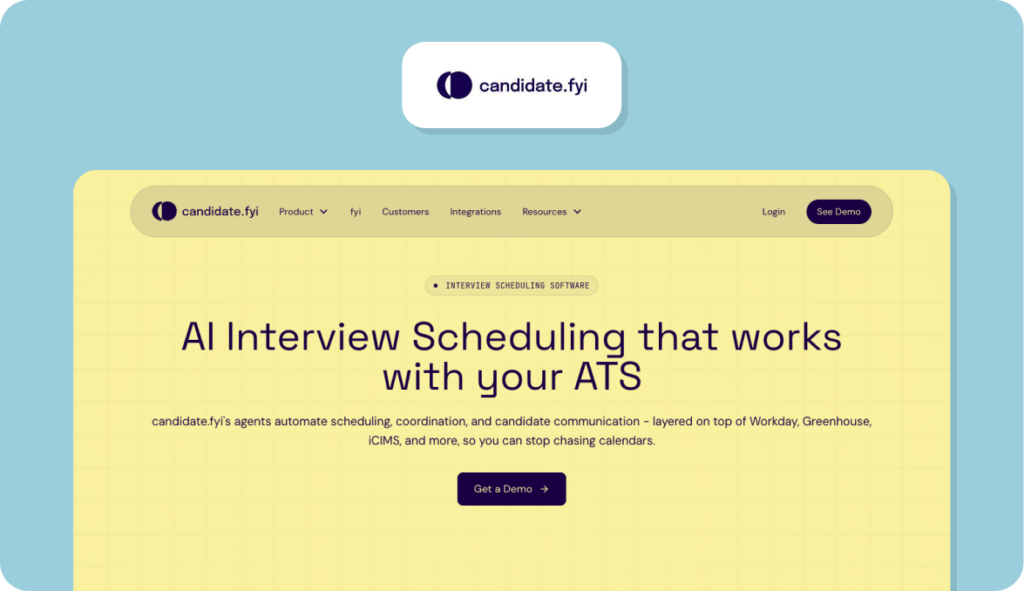
Best for: Teams competing for scarce candidates, where booking is part of the pitch.
What it does: Builds branded, mobile candidate portals consolidating the entire interview process – schedule, prep material, interviewer bios – in one place, with no ATS login required. It’s the most differentiated candidate-facing hiring experience in the category [criterion 3], and the closest thing here to treating scheduling as part of candidate experience rather than back-office admin, which is what keeps candidates engaged between stages.
AI vs. rules-based: Largely rules-based two-way sync and self-scheduling with an AI-assisted decline-and-rebook layer, though the company is more transparent than most about what its data shows.
Strengths: Two-way sync claimed across 40+ ATS platforms – the widest claimed bench here, though vendor-stated [criterion 1]. Its own recruiting coordination analysis reports time to schedule falling from 243 minutes to 27, and coordinator capacity rising from ~30 to 158 interviews per week [criterion 4]. Highest G2 rating in the category at 4.9/5, on a small base of ~26 reviews.
Where it falls short: Portal setup is reported as manual and slow, with one implementation cited at ~45 days. Frequent interface changes frustrate reviewers wanting stability, and it’s over-engineered if all you need is lightweight 1:1 booking.
Pricing: Quote-only. Third-party estimates circulate around $30K/year; treat as estimate, not vendor-confirmed [criterion 6].
Verdict: The best candidate-facing polish here, if you have runway for a portal build.
4. VidCruiter – best for global, multi-timezone scheduling
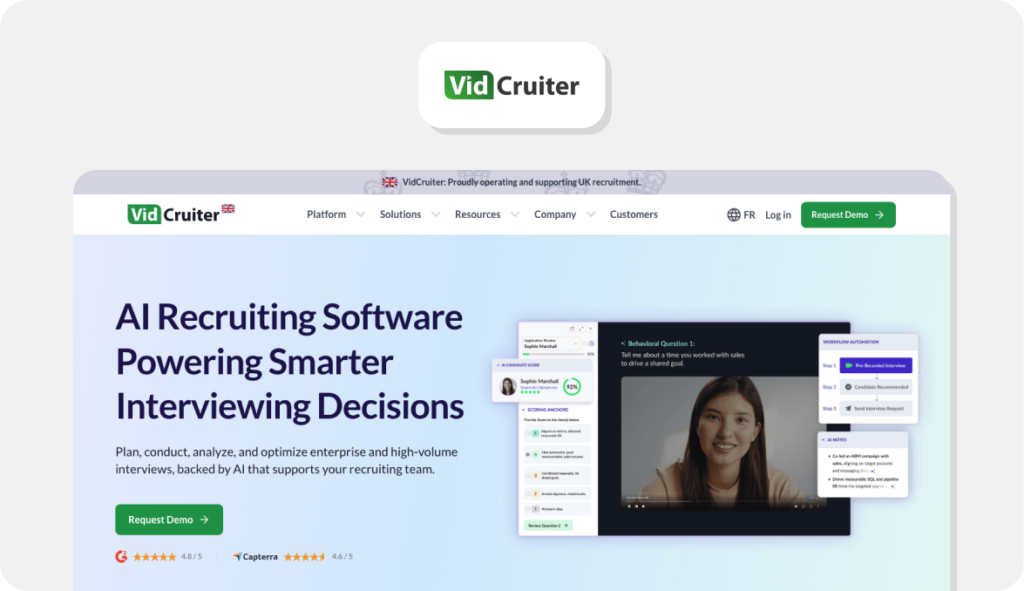
Best for: Organisations hiring across countries, languages and time zones, especially where video interviewing is already in the mix.
What it does: Filters invalid slots before candidates see them and matches availability across an entire panel first – removing the most common failure mode in global scheduling [criterion 2]. Timezone and language handling is a genuine strength [criterion 1], and scheduling sits alongside pre-recorded interviews and live video, useful if your interview process mixes recorded screens with in-person interviews later.
AI vs. rules-based: Predominantly rules-based, and VidCruiter is comparatively restrained in its AI claims. That’s honesty, not a weakness [criterion 5].
Strengths: A rare, specific outcome: RaceTrac reported a 167% increase in scheduled interviews and a 20% increase in attendance, taking show rates from around 50% to 70–85% – vendor-published, but attributed and unusually concrete [criterion 4].
Where it falls short: Complex implementation, and an interface reviewers call a bit outdated. Multi-interviewer panel setup is repeatedly described as tricky. No free trial, and opaque, bundle-dependent pricing.
Pricing: Quote-only, bundled by module [criterion 6].
Verdict: The strongest global-hiring option here – budget properly for implementation.
5. Yello – best for campus and event-day scheduling
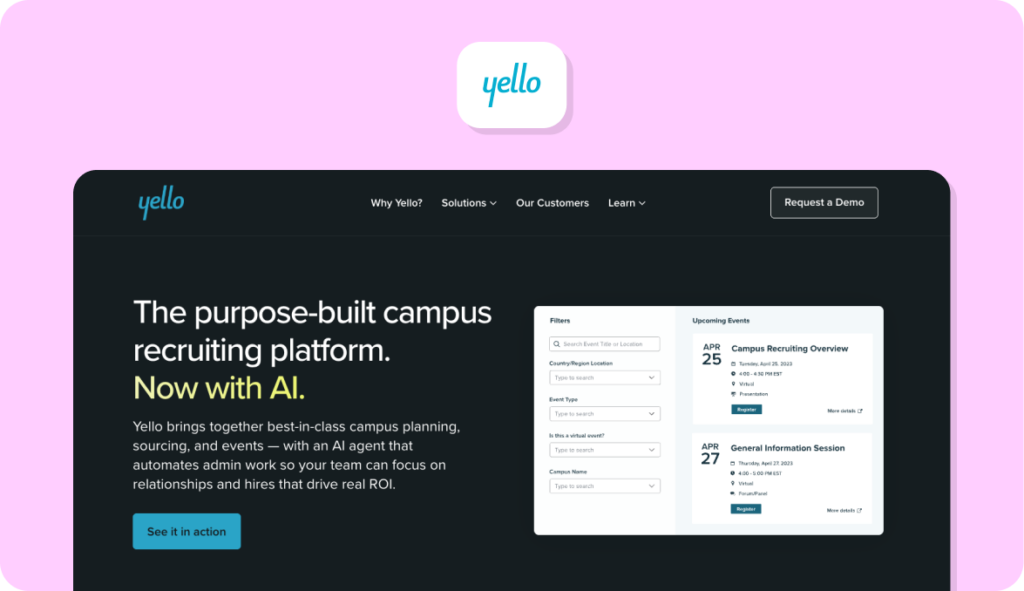
Best for: Early-careers teams running career fairs, super days and phone-screen blitzes.
What it does: Purpose-built for event-based AI recruiting scheduling interviews at density – hundreds of in-person interviews and group interviews in a day, in physical rooms, with real-time detection of room and calendar scheduling conflicts [criterion 2]. That’s a different problem from a four-person software panel, and almost nothing else here solves it.
AI vs. rules-based: Rules-based conflict resolution. Yello doesn’t lean on agentic framing, and shouldn’t be evaluated as though it does [criterion 5].
Strengths: Proven at genuine hiring volume – RPO provider Cielo schedules more than 30,000 interviews per month on the platform, per Yello’s own case study [criterion 4]. Event-day workflows are mature in a way generalist schedulers aren’t.
Where it falls short: A steep learning curve reviewers call difficult to self-navigate, and a Workday integration called out as expensive and difficult. Reporting is weak, and event-day reliability draws complaints – system freezes and Wi-Fi dependency are the wrong failure mode on the day 400 students turn up. Only the Greenhouse integration is independently verifiable.
Pricing: Quote-only [criterion 6].
Verdict: If your scheduling problem is an event rather than a loop, Yello is the specialist. If not, it’s the wrong tool.
6. Paradox (Workday) – best for conversational, frontline scheduling
Best for: High-volume frontline hiring where candidates live on their phones.
What it does: Paradox’s scheduling assistant works conversationally and SMS-first, as one module of a broader candidate-assistant platform. Candidates text to book, reschedule and confirm without opening a portal – the right interaction model for retail, hospitality, logistics and healthcare shift hiring [criterion 3].
The buying context has changed. Workday completed its acquisition of Paradox on 1 October 2025, and it now ships as part of Workday’s recruiting suite rather than as an independent point solution. You’re evaluating Workday’s roadmap, contracting and vendor risk – not a startup’s [criterion 1].
AI vs. rules-based: Conversational NLU over a scheduling engine – good at intent handling in SMS, but treat the broader agentic framing with the same scepticism you’d apply to anyone here [criterion 5].
Strengths: The strongest conversational booking experience for frontline candidates. One enterprise customer reported cutting candidate response time from 7 days to under 24 hours – vendor-published, verify directly [criterion 4].
Where it falls short: Weak analytics and reporting depth. Auto-scheduling degrades badly if hiring managers don’t keep team availability current – a people problem software can’t fix. Limited support for complex multi-interviewer panel loops relative to GoodTime or ModernLoop.
Pricing: Quote-only, increasingly negotiated as part of a Workday relationship [criterion 6].
Verdict: Excellent for frontline volume, questionable for corporate panel loops, now inseparable from a Workday decision.
7. Phenom – best for teams already buying a talent-experience suite
Best for: Mid-to-large organisations consolidating CRM, career site, internal mobility and scheduling under one vendor.
What it does: 24/7 automated scheduling and rescheduling with triggered communications, plus Personal Scheduling Links that let candidates self-book before they exist in your ATS or CRM – useful for recruiter-led and passive-candidate outreach [criterion 3]. Works with Microsoft, Google or Phenom’s own calendar, with process templates varying by job family and location.
AI vs. rules-based: Automation and templating with AI-assisted matching across the wider suite. Scheduling itself is closer to sophisticated workflow automation than autonomous agency [criterion 5].
Strengths: Phenom publishes a specific outcome – a transportation-sector customer reduced no-show rates by 20% and saved over 1,000 recruiter hours after implementing automated interview scheduling and reminders [criterion 4]. Because scheduling sits inside the suite, that data feeds the same system running the rest of the hiring process.
Where it falls short: Enterprise-only economics – third-party estimates put modules at $15K–$120K/year and full-suite deployments at $250K–$500K+/year (estimates, not Phenom-published). It doesn’t replace your ATS, so you carry dual vendor costs, and 4–6 month deployment timelines are frequently underestimated.
Pricing: Quote-only, sold as a suite module rather than a standalone SKU [criterion 6].
Verdict: Rational if you’re already consolidating on Phenom. Hard to justify as a standalone scheduling purchase.
Where Sapia.ai fits (and where it doesn’t)
Here’s the honest version.
Sapia.ai‘s core product is a structured, mobile-first, async AI chat interview for candidate assessment at volume. It is not scheduling software, and it doesn’t compete with the seven tools above.
Sapia does ship a real interview scheduling feature: a browser extension for bulk-scheduling live interviews, with automatic applicant tracking system and calendar sync, AI-generated time slots, and candidate self-booking that needs no ATS login. It’s a smart adjacency, removing the “now book the live round” friction that follows a structured async interview – exactly where high-volume teams lose momentum.
But measured against the criteria above, a single browser extension is not a peer to tools with years of iteration on panel logic, named enterprise references and independent review coverage. There’s no published no-show or panel-complexity outcome data behind it, and we’re not going to claim otherwise.
Look elsewhere if your standalone need is complex panel scheduling, a deep multi-ATS bench, or a proven no-show track record. Shortlist from the seven above.
Sapia is the right fit if your bottleneck sits upstream – you run high-volume hiring with structured async interviews and want the follow-up live round booked without leaving the workflow. Scheduling as a bonus, not the main event.
For scale: Woolworths, Australia’s largest private employer, completed roughly 27,000 hires in under 10 weeks with Sapia.ai alongside SAP SuccessFactors – an 83% reduction in time to hire, at a 9.2/10 candidate satisfaction score. If that’s your problem, book a demo and see the chat interview and its scheduling extension together.
How to choose: a 5-step selection process

- Map where your scheduling challenge actually sits – panel complexity, candidate no-shows, global timezone coordination, or event-day volume. These four problems have four different winners here, and buying for the wrong one is the most common failure. Pull the last 20 loops that went badly and categorise them.
- Shortlist two or three tools whose “best for” lane matches – not five, and not the ones with the best homepage.
- Score each against the six criteria, weighting integration depth and panel handling highest – for mid-to-large organisations, those two predict implementation success better than anything else.
- Press every vendor on criterion 5. Ask what their interview schedule AI agent actually decides – interviewer fatigue, skill matching, load balancing – versus what’s a rule you configured. A vendor who answers precisely is telling you something; so is one who can’t.
- Run a paid pilot on your messiest real loop – one of your genuinely complex scheduling scenarios, multi-panel and multi-timezone, not the easy case the vendor will steer you toward. Collect candidate feedback from that pilot alongside your coordinators’. Sign the annual contract after that, not before.
Conclusion
The best interview scheduling tools are the ones matched to the bottleneck you are actually solving – not the ones whose vendor says “AI” loudest.
- GoodTime and ModernLoop for complex panel loops – GoodTime for depth and ATS breadth, ModernLoop for interviewer certification.
- candidate.fyi if the candidate-facing experience is part of how you compete.
- VidCruiter for global, multi-timezone, video-bundled hiring.
- Yello for campus and event-day volume.
- Paradox and Phenom for suite consolidation – with Paradox now a Workday decision.
And if your real problem is the structured interview that comes before the scheduling problem, that’s a different purchase – closer to an AI assessment platform than a scheduler. See how Sapia.ai handles it, or read the case studies.
FAQs about AI scheduling software
AI interview scheduling is software that automates the interview scheduling process end to end: it matches candidate and hiring team availability, books the interview, sends confirmations and reminders, and handles rescheduling without a coordinator. More advanced interview scheduling AI also handles interviewer load balancing and replaces unavailable panel members.
Three concrete ones. It helps coordinators save time: candidate.fyi puts manual scheduling at 243 minutes per interview versus 27 with self-scheduling, pulling down time to hire. It lifts attendance: RaceTrac reported a 20% increase using VidCruiter. And it raises capacity roughly fivefold once you automate repetitive tasks. All vendor-published – verify against your baseline.
It depends on your bottleneck. GoodTime and ModernLoop lead on complex panel scheduling, VidCruiter on global coordination, Yello on campus and event volume. Talent acquisition teams at mid-to-large organisations should score shortlists against the six criteria above, weighting integration depth and panel handling most heavily.
An interview scheduling AI agent claims to reason about scheduling decisions – interviewer fatigue, skill matching, load balancing – rather than just intersecting calendars. Most AI-powered interview scheduling discloses too little technical detail to confirm genuine reasoning versus a rules engine with a chat interface. Ask exactly what the agent decides autonomously.
AI complex interview scheduling software matches availability across every panel member at once rather than sequentially, filters invalid slots before candidates see them, applies interviewer load balancing across a pool, and auto-replaces interviewers who drop out. GoodTime, ModernLoop and VidCruiter handle these complex scheduling scenarios best, including multi-day loops and group interviews. Basic scheduling tools do not.
Scheduling logic can introduce bias if slot allocation systematically disadvantages candidates in certain time zones, shift patterns or caregiving situations. Ask vendors whether theirs has been audited for disparate impact in who gets offered which slots. Most haven’t – audited fairness is more commonly evidenced downstream, in structured interviewing.
Almost the entire category is quote-only – none of the seven publishes a rate card. Third-party estimates exist (roughly $30K/year for candidate.fyi, $15K–$120K/year per Phenom module), but get a live quote. ModernLoop’s separate Taylor AI voice product is the rare exception at $450–$1,250/month.
No. Scheduling tools sit alongside your applicant tracking system, not instead of it. The ATS stays the system of record for requisitions, candidates and interview stages across the entire hiring process; the scheduler reads from it and writes back. That means dual vendor costs – and makes native two-way ATS integration the single most important criterion.
About Author