Why candidates love chat-based interviews (and what the numbers show)

TL;DR
- A chat-based interview is a structured, text interview that candidates complete asynchronously, on their own time, typically on a mobile device.
- Candidates prefer the format over phone and video screening because it removes performance anxiety, fits around their schedule, and is fair.
- For hiring teams, the format delivers a ranked shortlist in real time, reduces time to offer, and cuts candidate leakage that slows down pipelines.
- Sapia.ai has completed more than 10 million interviews across over 47 countries, with 99% positive candidate sentiment recorded across those interactions.
TA teams feel pressure to scale interview capacity without sacrificing quality or fairness.
The thing that prevents most teams from achieving this isn’t a lack of candidates. Instead, it’s a lack of comparable, consistent evidence to make confident decisions.
When your screening process fails to produce consistent signals across candidates, your decision-making process slows down. Shortlists get muddled. And strong candidates drop off before anyone has a chance to assess them. Everything becomes harder than it needs to be.
Chat-based interviews address this problem directly. In this article, we cover what chat interviews are, why candidates prefer them, and what the data shows about their impact at scale.
What is a chat-based interview?
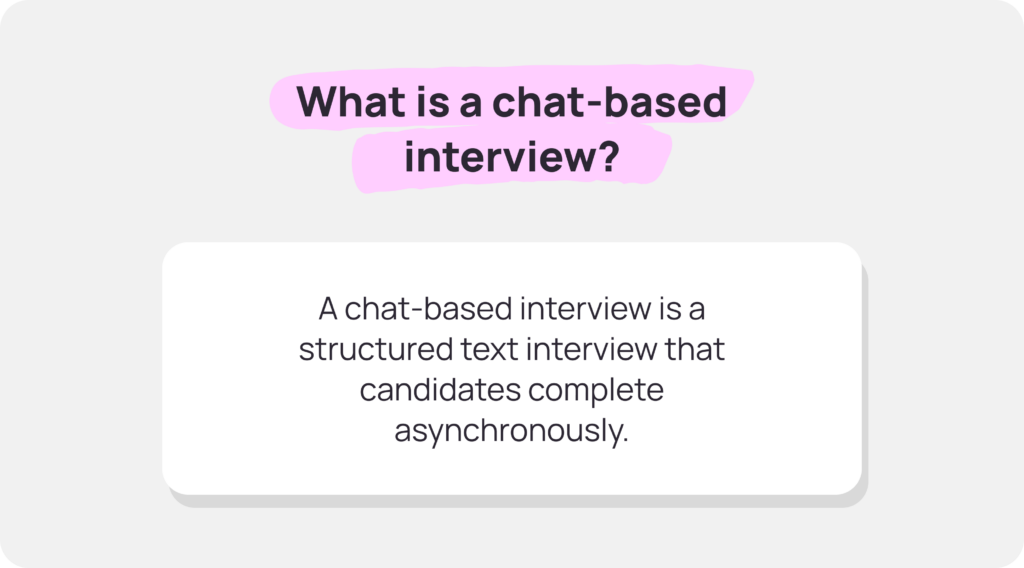
A chat-based interview is a structured text interview that candidates complete asynchronously.
Said candidates receive a set of job-relevant structured questions and respond in their own time, typically on a mobile device. There’s no fixed time slot to book, formal setting to travel to, or live interviewer to impress. These facts make chat-based interviews convenient.
What a chat-based interview is not
Chat-based interviews are not the same as live chat interviews or AI chatbot interviews.
A live chat interview is synchronous and human-led. Think of it as a real-time conversation, conducted via text message, between a candidate and a recruiter or hiring manager.
An AI chatbot interview is usually unstructured and FAQ-style. It’s typically designed to answer candidate queries rather than assess their personal experiences or hard and soft skills.
Where Sapia.ai fits
Sapia.ai offers true chat-based interviews. Our platform uses natural language processing and deep learning to ask candidates relevant questions, score their responses against validated competency rubrics, and even deliver detailed feedback once the interview concludes.
Equally as important, every interview question connects to job requirements for the specific role you’re hiring for, and scoring is consistent across every candidate who participates.
Our AI chat interview tool is built for both high-volume and frontline roles, as well as professional and skilled positions.
Why candidates prefer the chat format
Candidates choose chat-based interviews over phone screens and video calls because of familiarity.
They craft responses to written communications every day. Asking them to do the same for an initial interview removes performance pressure and enables them to display their abilities.
But it’s about more than comfort. Chat-based interviews are also more convenient and inclusive.
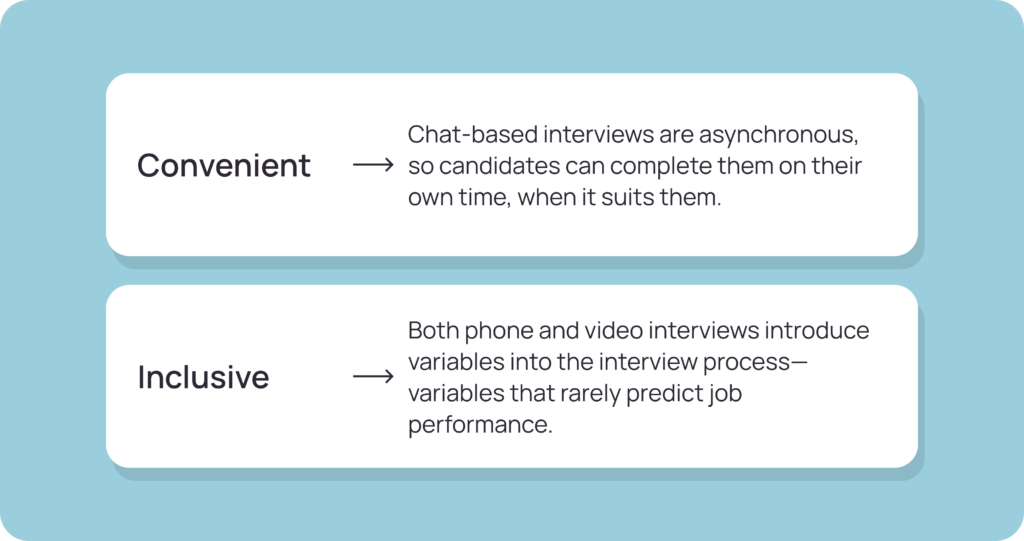
- Convenient: Chat-based interviews are asynchronous, so candidates can complete them on their own time, when it suits them. This level of convenience is important for job seekers who work other jobs, have unpredictable schedules, and/or apply in different time zones.
- Inclusive: Both phone and video interviews introduce variables into the interview process—variables that rarely predict job performance. We’re talking about the sound of someone’s voice, the lighting in their room, and unforeseen technical issues. For video specifically, eye contact, body language, and facial expressions can also be factors. Candidates with disabilities, non-native speakers, and introverts are often at a disadvantage because of this.The chat format makes sure they have an opportunity to shine.
Plus, when you use a tool like Sapia.ai, every candidate gets personalised feedback. What did they do well? How can they improve their chances of getting hired in the future? After studying candidate feedback, we found that this feature was a meaningful differentiator in the market.
What the data actually shows
We based the claims above on facts. The average candidate happiness score for those who go through our chat interview process is 9.1 out of 10, consistent across all demographic groups.
Companies that put candidates through our combined chat and video interview flow achieve an average completion rate of 75.4%, and the average time to offer drops to 39 hours. Finally, we’ve hosted 10 million interviews in over 47 countries, and the Sapia.ai platform recorded 99% positive candidate sentiment.
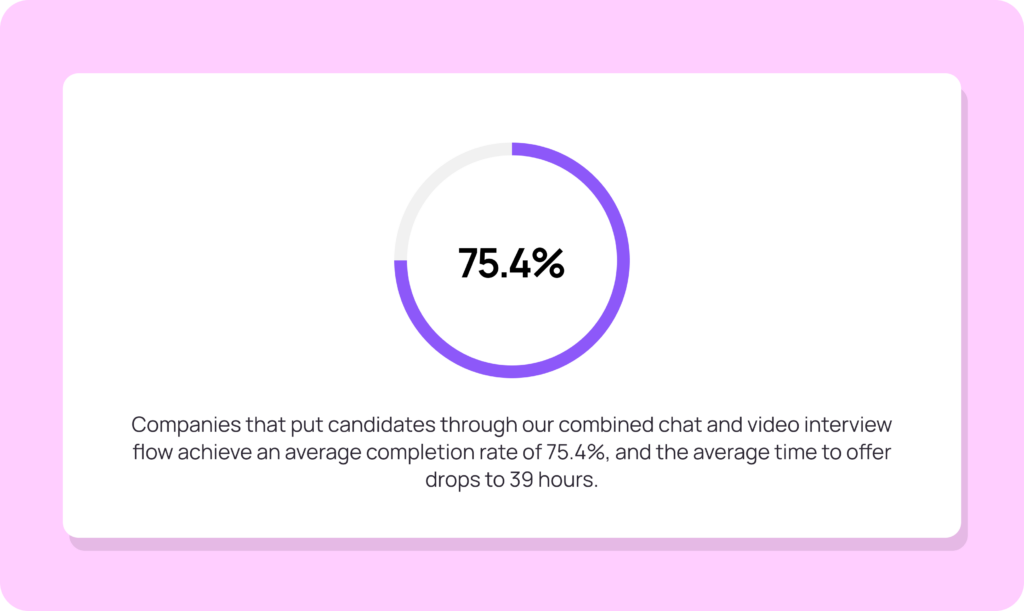
These figures aren’t estimates. Sapia.ai tracks completion and satisfaction data in real time through our DiscoverInsights dashboard, which segments metrics by funnel stage, device, and time of day. Users can see exactly where candidates are engaging, where drop-off occurs, and what drives it. So, we know precisely how Sapia.ai improves the hiring process, from initial job interview to offer.
What chat-based interviews mean for hiring teams
When candidates complete chat interviews, hiring managers have a wider, fairer talent pool to shortlist from. As such, they can recruit the best people for the job, not the people who only have polished resumes. This ability leads to better outcomes for everyone involved.
But when candidates complete chat interviews inside Sapia.ai, the real magic happens. Our platform delivers ranked shortlists in real time to your ATS or Talent Hub, with a full Talent Insights profile for each candidate. That way, you can easily trace scores back to real responses. This ability enables hiring teams to see the reasoning behind decisions, not just the numbers.
The result? Scheduling, sifting, and chasing become smaller parts of the job, so recruiters can spend time on the candidates who matter. For teams hiring at speed and/or volume, this is incredibly valuable.
Chat-based interviews also reduce candidate leakage between stages. When hiring managers arrive at the live interview with a full Talent Insights profile in hand, they can focus their conversations and make a decision faster. They simply ask a few follow-up questions to clarify fit.
The employer brand case
Candidate experience and employer brand are connected.
How someone feels about your hiring process shapes how they talk about your company. A bad screening experience gets shared. A good one creates advocates.
Chat-based interviews consistently generate positive sentiment from both successful candidates and rejected ones. This is because everyone gets an interview and personalised feedback, which signals respect for each person’s time and effort, regardless of outcome.
Sapia.ai tracks this through the DiscoverInsights “Candidate Love” dashboard. It measures satisfaction and employer brand advocacy in real time. For TA leaders who are accountable for their company’s reputation in the talent market, this level of visibility is valuable.
Build a better interview process
Chat-based interviews are preferred by candidates.
Hiring teams like them, too, because they expand the talent pool beyond those with a polished CV, which produces better, more consistent signals for recruitment. Plus, chat-based interviews deliver faster decisions and reduce the drop-off that drains pipelines. All the data backs this up.
Want to see chat-based interviews in action? Book a demo with Sapia.ai today.
FAQs about chat-based interviews
A chat-based interview is a structured text interview that candidates complete asynchronously on mobile or desktop devices. Said candidates answer a set of job-relevant questions in their own time, and a scoring engine evaluates their responses against validated competency models. The process is simple and requires no interview prep, but still allows hiring teams to assess personality traits, communication styles, and other qualities that predict job performance.
A chatbot interview is unstructured and FAQ-style. A live chat interview is synchronous and human-led. A chat-based interview, like what Sapia.ai delivers, is a structured assessment that’s automatically scored using natural language processing. It’s not a conversation or a support tool.
The format removes the pressure associated with video calls and fits around candidates’ schedules. Plus, everyone gets personalised feedback after completing, which is rare in traditional screening.
Sapia.ai customers record an average completion rate of 75.4% for their combined chat and video interview flow. This metric is tracked in real time through the DiscoverInsights dashboard. Our platform keeps all data secure with the latest technology and strict adherence to regulations.
Sapia.ai uses natural language processing and deep learning to score responses against validated competency rubrics. After completion, candidates receive personalised feedback, and hiring teams receive a ranked shortlist with full Talent Insights profiles. This information can then be used during actual interviews to ask situational questions, behavioral questions, and every other kind of question you can think of. The way candidates respond will inform your hiring decisions.
About Author