Candidate Interview Experience: 8 Ways to Improve Hiring Conversations (and How to Measure It)


TL;DR
- The candidate interview experience is how candidates see the interview stage, from invitation to decision. It covers how well they were prepared, how fair and job-related the questions felt, how they were treated, how long it took, and whether they heard back.
- A better experience and a better hiring decision come from the same design choices: job-related structured questions, clear expectations, fast decisions, accessible formats and honest AI disclosure. You don’t have to trade one for the other.
- The eight strategies: set expectations, structure the interview, cut rounds, design for access, train interviewers, disclose AI, close the loop, and measure by outcome.
- The fastest win: tell every candidate the outcome, and decide within days, not weeks.
Most candidates don’t remember your careers site. They remember the interview: who turned up late, which questions made no sense, and how long they waited to hear nothing.
That silence is common. 61% of job seekers say they’ve been ghosted after an interview (Greenhouse, 2024, vendor survey of 2,500 candidates in the US, UK and Germany). And AI is now in the interview itself. 63% of US job seekers have had an AI interview, and 38% have walked away from a hiring process because of one (Greenhouse 2026 AI Interview Report, vendor survey, n=2,950).
This guide zooms in on the interview stage of the candidate experience. For each of eight strategies you’ll get:
- the evidence behind it, labelled as independent or vendor data
- what to do, and what good looks like
- the mistake to avoid
- the one metric to track
You’ll also get a seven-question post-interview survey you can copy, and an honest view of where technology helps and where it just adds a step.
A disclosure: Sapia.ai makes an AI interview tool. We’ve assessed 10M+ candidates (vendor-reported) and publish an independent audit of our own scoring, so we’ve tried to hold this guide to the standard we’d want applied to us.
What makes a great candidate interview experience (and how we chose these 8 strategies)
A meta-analysis of 86 samples and nearly 49,000 people found that candidates judge a process as fair mainly when it looks relevant to the job and likely to predict performance – and those judgements shape whether they’d recommend you or accept an offer (Hausknecht, Day & Thomas, 2004, independent).
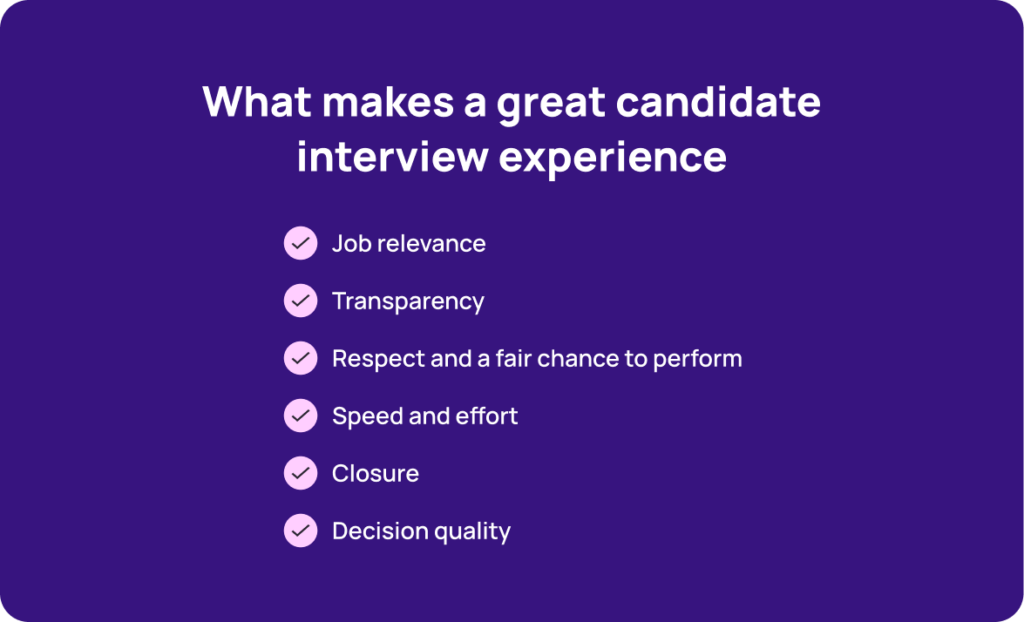
We used six lenses to choose the strategies, and tag each strategy with the ones it serves:
- Job relevance. Do the questions obviously relate to the job?
- Transparency. Do candidates know the format, length, who they’ll meet, what’s assessed, whether AI is involved and the pay range, before they start?
- Respect and a fair chance to perform. Are candidates treated courteously, asked lawful questions and given the adjustments they need?
- Speed and effort. How many rounds, how long between stages, how much scheduling back-and-forth?
- Closure. Does everyone hear the outcome, and do finalists get useful feedback?
- Decision quality. Does the change also make the hiring decision more accurate and consistent?
We left out tips that feel nice but have no evidence behind them, or that make decisions less consistent – for example, letting each interviewer improvise their own questions to “build rapport”.
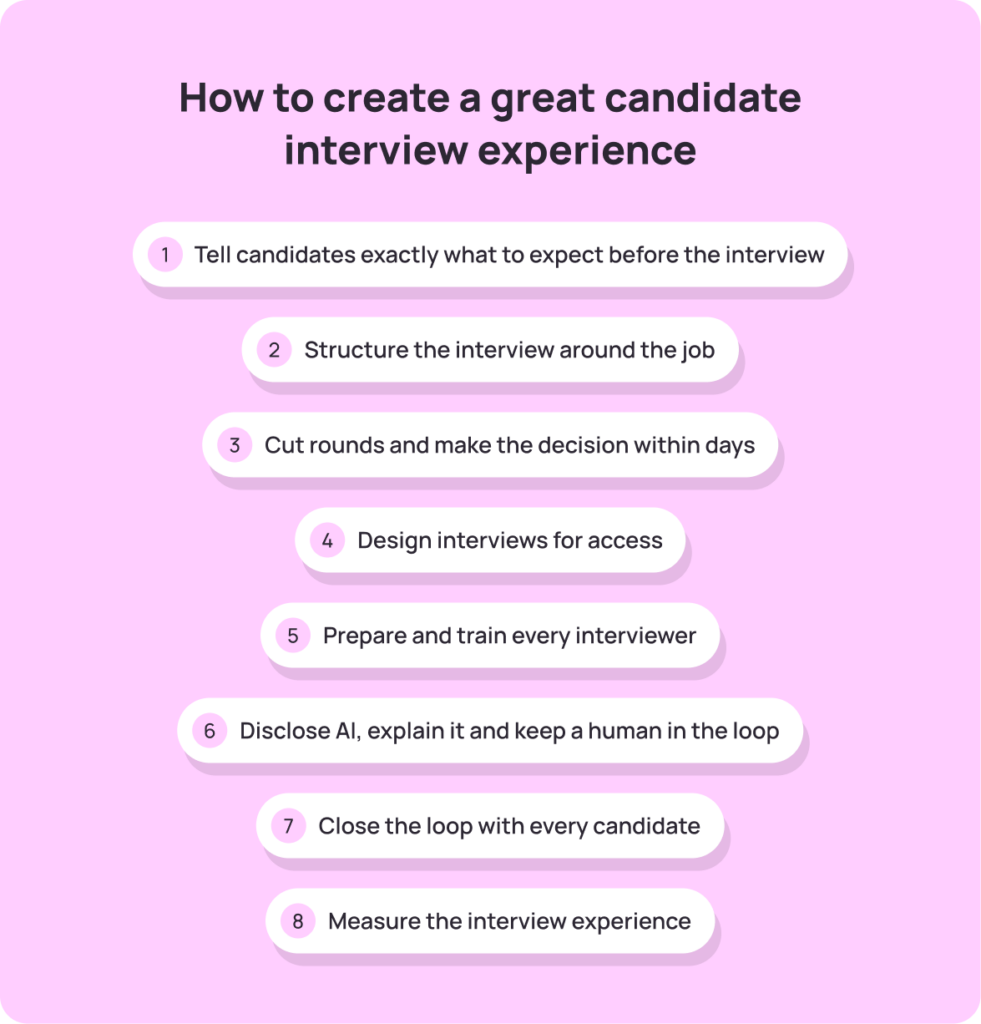
How to create a great candidate interview experience: 8 strategies
| # | Strategy | What changes for the candidate | Strongest evidence | Metric to track | Effort |
| 1 | Tell candidates what to expect | No surprises on format, people, AI use or pay | Applicant-reactions research (independent); Greenhouse 2026 (vendor) | “I knew what to expect” score | Low |
| 2 | Structure the interview around the job | Same job-related questions, scored fairly | Sackett et al. 2022 (independent); CandE 2025 (vendor-run benchmark) | Interviewer agreement; “questions were relevant” score | Medium |
| 3 | Cut rounds and decide within days | Shorter process, fewer reschedules | CandE 2025 (vendor-run benchmark); Ashby (vendor) | Days from first interview to decision | Medium |
| 4 | Design for access | A format that lets them perform | Equality Act / ADA duties (law); CIPD 2024 (independent) | Adjustments fulfilled; completion by format | Low–medium |
| 5 | Prepare and train interviewers | A courteous, lawful, focused conversation | Interview research (independent); Greenhouse 2025 (vendor) | % of interviewers trained | Medium |
| 6 | Disclose AI, keep a human in the loop | Knows when AI is used and who decides | Gartner 2025 (independent); Greenhouse 2026 (vendor) | Completion and withdrawal at the AI stage | Medium |
| 7 | Close the loop with everyone | Always hears back; finalists get feedback | CandE 2025 (vendor-run benchmark); Greenhouse (vendor) | % with an outcome within your target time | Low |
| 8 | Measure, segmented by outcome | Is asked, and sees things change | Hausknecht et al. 2004 (independent); Starred (vendor) | Post-interview cNPS by stage and outcome | Low |
1. Tell candidates exactly what to expect before the interview
Why it matters. Explaining the process in advance improves how candidates rate it (SIOP applicant-reactions white paper, summarising independent research). The biggest current gap is AI. 70% of US candidates say AI wasn’t clearly disclosed before their most recent AI interview (Greenhouse 2026, vendor survey). Only 31% of candidates were told in advance that they’d face an AI-led interview (Gartner, June 2026, independent; small sample of 254).
What to do. Send a standard “what to expect” message before every stage. Cover:
- the format: live, video, chat or voice
- how long it takes, and whether it’s timed
- who they’ll meet, and their roles
- what’s being assessed (the competencies, not the questions)
- whether AI is used, how, and who makes the decision
- the pay range
- how to request adjustments
- when they’ll hear back
Our interview invitation email templates give you a starting point.
What good looks like: a one-screen “what to expect” block a candidate can read on a phone.
The mistake to avoid: surprise panels, surprise case studies, surprise AI.
Why it’s becoming a legal question too. The EU Pay Transparency Directive requires pay information before the interview (Directive 2023/970; national rules vary). EU AI Act Article 50 requires telling people they’re interacting with an AI system from 2 August 2026. Illinois’ AI Video Interview Act requires notice and consent for AI-analysed video interviews. This isn’t legal advice, so confirm your obligations with counsel.
Metric: the share of candidates agreeing “I knew what to expect” in your post-interview survey. Lenses: 2, 3.
2. Structure the interview around the job
Why it matters. This is where experience and decision quality line up most clearly. In the most recent large review of selection methods, structured interviews had the highest average validity for predicting job performance, at about .42, against about .19 for unstructured interviews (Sackett, Zhang, Berry & Lievens, 2022, independent; treat these as current best estimates, since the corrections are debated). Candidates also rate interviews among the fairest selection methods (Hausknecht et al., 2004). And the 2025 CandE award winners used structured interviews more often and earned 13% higher fairness ratings for their interviews (CandE/Survale, 2025; the benchmark is run by a survey vendor).
What to do.
- Derive five to eight competencies from a job analysis.
- Write the same job-related behavioural and situational questions for every candidate. Our guide to competency-based interview questions shows how.
- Score each answer against a rating scale with a clear description of what each level looks like. Use interview score sheets to keep panels consistent.
- Score before you discuss, so one loud opinion doesn’t set the result.
More on the trade-offs in structured vs unstructured interviews.
What good looks like: a candidate can see why every question was asked.
The mistake to avoid: brainteasers, “culture fit” chats with no criteria, and questions that change with each interviewer.
Where Sapia fits: our Job Analysis Studio turns a role into a competency-based structured interview, and our chat interview asks every candidate the same job-related questions and scores their answers, not their CV.
Metric: agreement between interviewers’ scores, and the share agreeing “the questions were relevant to the job”. Lenses: 1, 3, 6.
3. Cut rounds and make the decision within days
Why it matters. Among the 2025 CandE award winners, 60% of the North American top ten make hiring decisions within three to five days. Making an offer within a week of the final interview raised candidates’ willingness to refer by 108% (CandE/Survale, 2025, vendor-run benchmark). Delay costs you even with the people you reject: Ashby found candidate net promoter score (cNPS) among rejected candidates fell 54.9% when the process ran 60 days or more (Ashby, 2023, vendor data). With applications per hire roughly tripling since 2021 (Ashby, May 2026, vendor data), slow stages compound.
What to do.
- Audit every round, and remove any that doesn’t assess a distinct competency.
- Combine panel members into one structured session where you can.
- Set a decision deadline for each stage, and hold hiring managers to it.
- Let candidates schedule themselves.
There’s no credible recent independent data on the “right” number of interview rounds. The useful test is simpler: does each round assess something the others don’t?
What good looks like: a published timeline, such as “three stages, and a decision within five working days of your final interview”.
The mistake to avoid: adding rounds to make up for unstructured interviews that didn’t produce a clear answer.
Metric: median days from first interview to decision, and drop-off between stages. Lenses: 4, 5.
4. Design interviews for access – and offer adjustments to everyone
Why it matters. In the UK, the Equality Act 2010 extends the duty to make reasonable adjustments to job applicants (s.20), and Acas notes that neurodivergence will often count as a disability, with or without a diagnosis. In the US, the ADA duty to accommodate applicants still applies, even though the EEOC withdrew its AI guidance in January 2025. Yet only 15% of UK organisations train interviewers on neuroinclusion (CIPD, 2024, independent).
What to do.
- Ask every candidate what they need, not just those who disclose a condition.
- Offer a choice of format where you can.
- Share topics or competencies in advance.
- Avoid time pressure that the job doesn’t require.
- Make every step work on a phone.
- Build breaks into longer sessions.
CIPD’s selection guidance also recommends telling all applicants the format, length and technology in advance. Our guide to an inclusive interview process goes further.
What good looks like: an adjustments question in every invitation, with a named person to contact.
The mistake to avoid: a camera-on, timed, one-take format as the only way in.
Where Sapia fits: our chat interview is untimed, text-based and works on any phone. There’s no camera or voice, and candidates can take time to think or come back later. It’s one practical way to take pressure off a first-stage interview, though no single format suits everyone.
Metric: adjustment requests fulfilled, and completion rate by format. Lenses: 3, 1.
5. Prepare and train every interviewer
Why it matters. Interviews predict performance better when interviewers are trained, take notes and score against defined rating scales (Levashina, Hartwell, Morgeson & Campion, 2014, independent review). Skipping it costs candidates too: 53% of job seekers say they’ve faced illegal or discriminatory interview questions (Greenhouse, 2025, vendor survey).
What to do. Make a short training mandatory before anyone joins a panel. Cover:
- the interview guide and the competencies being assessed
- lawful and unlawful questions
- note-taking and scoring against the rating scale
- basic courtesy: start on time, introduce the panel, leave time for the candidate’s questions
Then brief every interviewer before each interview: the CV, the competencies, and which questions they own.
What good looks like: nobody sits on a panel without completing the training.
The mistake to avoid: the hiring manager reading the CV for the first time in the room.
Metric: the share of interviewers trained, and the share of candidates agreeing “the interviewer was prepared”. Lenses: 3, 6.
6. If AI is part of the interview, disclose it, explain it and keep a human in the loop
Why it matters. Trust is low. Only 26% of candidates trust AI to evaluate them fairly (Gartner, July 2025, independent). In Greenhouse’s 2026 survey (vendor data; Greenhouse sells a voice AI interviewer):
- 38% had withdrawn from a process because of an AI interview
- the top reason (33%) was a pre-recorded video scored by AI with no human present
- 46% want the option of a human interview
- 51% of US candidates who completed an AI interview never got an outcome
Not all the data points one way: Bullhorn reports 92% of candidates rated AI voice interviews as good as or better than human ones (Bullhorn, September 2026, vendor survey; Bullhorn sells an AI voice screener). Research explains the split: candidates see automated interviews as more consistent, but less personal (Langer et al., 2020, independent).
What to do.
- Tell candidates before they start that AI is involved, what it assesses and who makes the decision.
- Make sure a person reviews AI output before decisions are made.
- Offer an alternative route on request.
- Send an outcome to everyone who completes an AI stage.
Before you buy, ask every AI interview vendor five questions:
- What does the candidate actually produce – written answers, voice, video, a test?
- What is the score built from – the candidate’s answers only, or answers blended with CV or profile data?
- What validity evidence is published, and what kind?
- Is there an independent, published bias audit of this specific product, analysed role by role rather than pooled?
- What integrity controls exist, and are their limits published?
Question four matters more than it looks: a 2026 study found role-level adverse impact that one vendor’s pooled audits had hidden (Bommasani et al., FAccT 2026, independent). Ask every vendor for role-level results – Sapia included.
Candidates use AI too, so integrity controls matter. But detection has its own fairness problem: AI-text detectors wrongly flagged 61% of essays by non-native English writers as AI-written, on average (Liang et al., 2023, independent). Ask any vendor for its false-positive rate for non-native writers.
The legal picture. EU AI Act transparency duties apply from 2 August 2026, with high-risk obligations for hiring tools delayed to 2 December 2027 (White & Case). Colorado requires notice and human review on request from January 2027 (Seyfarth), and UK safeguards for significant automated decisions apply from February 2026. Confirm with counsel.
Where Sapia fits: we score the candidate’s interview answers without using their CV, school or employers, and publish an independent bias audit: BLDS, late 2022, 72 tests on our US and Canada models, finding no evidence of practically significant disparate impact. We also detect AI-generated answers and publish detection and false-positive figures (vendor-reported).
Metric: completion and withdrawal rates at the AI stage, and the share agreeing “I understood how AI was used”. Lenses: 2, 3, 6.
7. Close the loop with every candidate – and give finalists real feedback
Why it matters. Silence is the most common complaint. 61% of job seekers say they’ve been ghosted after an interview (Greenhouse, 2024, vendor survey); in the UK the figure is 56% and in Ireland 66% (Greenhouse, February 2026, vendor survey). Fixing it pays off: giving finalists feedback raised their willingness to refer by 69% (CandE/Survale, 2025, vendor-run benchmark).
What to do.
- Set an outcome deadline for every stage.
- Automate outcome messages for early stages, so nobody slips through.
- Give finalists specific, job-related feedback tied to the competencies. This is much easier when the interview was structured (strategy 2).
- Invite strong unsuccessful candidates into a talent pool for future roles.
What good looks like: nobody who interviewed waits more than a set number of working days for an outcome.
The mistake to avoid: “we’ll be in touch” with no date, and silence after an AI interview.
Where Sapia fits: every candidate who completes a Sapia interview receives personalised insights about themselves and their interview. Our Talent Intelligence Assistant can also resurface strong past candidates for new roles, based on what they said in their Sapia interviews rather than a CV match.
Metric: the share of interviewed candidates who get an outcome within your deadline. Lenses: 5, 3.
8. Measure the interview experience – and segment by outcome
Why it matters. Candidates’ ratings track how well they think they did and whether they got the job (Hausknecht et al., 2004). So a single, unsegmented score mostly tells you your rejection rate. Vendor benchmarks show how big the gap is: cNPS of +81 for hired candidates, +40 for those who withdrew and –7 for rejected candidates (Starred, vendor data, 2025).
What to do. Send a short survey after each interview stage, about the process. Send a separate survey after the decision. Report the results by stage, outcome, role family and interview format. The next section gives you the questions.
Metric: post-interview cNPS by stage and outcome. Lenses: all six.
Candidate interview experience survey: what to ask and when
A candidate interview experience survey should be short, sent soon after the interview, and read separately for hired, rejected and withdrawn candidates.
When to send it. Send a short survey within 24–48 hours of each interview stage, focused on the process. Send a separate post-decision survey later; Starred recommends 48–96 hours after the offer or rejection, with one reminder (Starred, vendor guidance). Analyse the two separately.
How long. Five to seven questions. Ashby found similar response rates for surveys of up to ten questions, falling after that (Ashby, 2023, vendor data). Make anonymity optional rather than compulsory: always-anonymous surveys got lower response rates in the same data.
Seven questions you can copy:
- Before the interview, I knew what to expect (format, length, who I’d meet). (1–5)
- The questions were relevant to the job. (1–5)
- I had a fair opportunity to show my skills and experience. (1–5)
- The interviewer(s) were prepared and treated me with respect. (1–5)
- If AI was used, I understood how, and who made the decision. (1–5, or N/A)
- How likely are you to recommend applying here to a friend? (0–10)
- What one thing would have made this interview better? (open text)
How to calculate cNPS. Question 6 gives you candidate net promoter score. Candidates scoring 9–10 are promoters and 0–6 are detractors; cNPS is the percentage of promoters minus the percentage of detractors. Survale suggests +20 or above is good (Survale, vendor guidance), but the most useful comparison is with yourself: same stage, same outcome, over time.
Close the loop. Tell future candidates one thing you changed because of the feedback.
For full templates by stage and how to analyse the results, see our guide to candidate satisfaction surveys.
Where technology helps – and where it doesn’t
Strategies 1, 3, 5 and 7 need process discipline more than software. Technology helps most with scale and consistency.
| Category | How it helps the interview experience | Examples (as of September 2026) | Honest limitation |
| Scheduling and self-scheduling | Candidates choose slots, reschedule themselves and get reminders | GoodTime; Paradox (owned by Workday since October 2025) | Speeds up logistics, but can’t fix too many rounds |
| Interview intelligence and notetakers | Interviewers listen instead of typing; notes mapped to the scorecard | Metaview; BrightHire (owned by Zoom since December 2025) | Recording needs consent; summaries can drift from what was said |
| AI interviewers: voice and video | Available around the clock; the same questions and rubric for everyone | HireVue AI Interviewer (voice, June 2026); Greenhouse voice AI (via Ezra, May 2026); SHL Smart Interview; SmartRecruiters Winston Interview (April 2026) | No published independent audit found for HireVue’s voice product; pre-recorded, AI-scored video with no human was the top reason candidates dropped out in Greenhouse’s 2026 survey (vendor data) |
| AI interviewers: text and chat | Untimed, no camera or voice, works on any phone | Sapia.ai (chat interview, with async video as an optional second stage) | Not the right format where spoken communication is the job |
| Candidate-experience surveys | cNPS by stage, benchmarks | Survale (owns the CandE benchmark since April 2025); Starred | The benchmark owner also sells the survey tool, so treat benchmarks as vendor data |
Several of these products launched or changed owner in the last 18 months. Check each vendor’s current site before you buy.
Before you buy any AI interview tool, ask the five questions from strategy 6. For a deeper look at the categories, see our guides to interview intelligence platforms and AI structured interviews.
Where Sapia fits (and where it doesn’t)
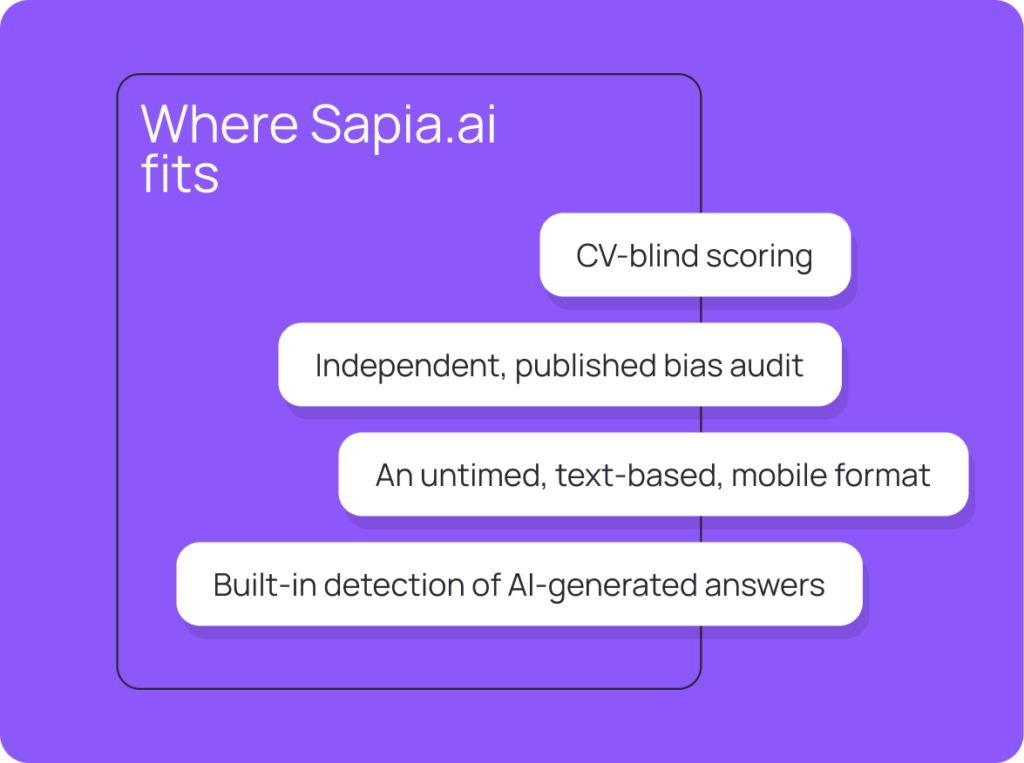
Our lane: the first interview stage. Sapia runs a mobile-first, untimed, text-first structured chat interview that asks every candidate the same job-related questions. Four things set it apart:
- CV-blind scoring. The score rests on the candidate’s answers, not their CV, school or employers.
- An independent, published bias audit with a named auditor. BLDS ran 72 tests on our US and Canada models in late 2022 and found no evidence of practically significant disparate impact.
- An untimed, text-based, mobile format. No camera, no voice, time to think, and it works on any phone.
- Built-in detection of AI-generated answers, with published detection and false-positive figures (vendor-reported).
In practice (customer-reported): Woolworths reached 82.6% completion and a 9.2/10 candidate experience rating across its volume hiring. Spark NZ rated the experience 8.9/10. More in our case studies.
Where we don’t fit, and what to choose instead:
- Spoken communication is the job, and you want a voice interview inside your ATS on your own rubric: Greenhouse’s voice AI or HireVue’s AI Interviewer.
- The deepest published psychometric validity documentation: SHL’s assessment portfolio publishes more than we do.
- Coding roles: a technical assessment tool.
- An ATS or scheduling tool: Sapia isn’t one. It sits on top of the ATS you already run, through integrations.
What you should still ask us: our audit is from late 2022 and covers US and Canada models only. Ask us, and every other vendor, for newer, role-by-role results. Ask for our AI-detection false-positive rate for non-native English writers, too.
If your first interview stage is where candidates drop out or feel judged on the wrong things, a structured, CV-blind, untimed chat interview is one practical way to fix it at volume. See how Sapia’s chat interview works, or book a demo.
How to improve your candidate interview experience in 30 days – a 5-step process
- Take a baseline. Pull stage drop-off, days to decision and any survey data for one role family. Launch the seven-question survey above.
- Fix the free wins. Add a standard “what to expect” message (strategy 1), an outcome deadline (strategy 7) and an adjustments question in every invitation (strategy 4).
- Structure one interview guide. Competencies, shared questions, defined rating scales and trained interviewers (strategies 2 and 5).
- Remove a round or a delay. Merge or cut one stage and set a decision deadline (strategy 3). If AI is in the process, add disclosure and a human-review step (strategy 6).
- Re-measure and compare like with like. After 30 days, compare cNPS by stage and outcome, completion and days to decision against your baseline. Keep what moved the numbers.
Conclusion
The interview is where candidates decide whether your process is fair. The choices that earn that trust – job-related structure, transparency, speed, access and closure – are the same ones that lead to better hiring decisions.
Most of the eight strategies cost little more than discipline: a clear message before the interview, a shared question set, a decision deadline and an outcome for everyone. Where scale is the problem, a structured, CV-blind, untimed interview helps you keep those promises to thousands of candidates at once. See how Sapia does it.
FAQs
The candidate interview experience is how candidates perceive the interview stage of hiring, from the invitation to the decision. It includes how clearly they were prepared, how fair and job-related the questions felt, how they were treated, how long the process took, and whether they heard back.
Tell candidates what to expect, ask every candidate the same job-related questions, keep rounds to a minimum and decide within days, offer adjustments to everyone, train interviewers, disclose any AI use, give every candidate an outcome, and survey candidates after each stage.
Prioritise the free wins: a clear “what to expect” message, a decision deadline for every stage, and an outcome for everyone who interviews. These take hours to set up, not weeks, and they address the complaints candidates raise most often: surprises, delays and silence.
Use a structured first-stage interview that candidates can complete on a phone in their own time, let them schedule later stages themselves, automate outcome messages so nobody is left waiting, and track completion and cNPS by stage to catch drop-off early.
Ask five to seven questions: whether candidates knew what to expect, whether the questions were relevant, whether they had a fair chance to show their skills, whether interviewers were prepared and respectful, whether AI use was clear, a 0–10 recommendation question, and one open question.
Ask candidates how likely they are, from 0 to 10, to recommend applying to your organisation. Subtract the percentage scoring 0–6 (detractors) from the percentage scoring 9–10 (promoters). Always report cNPS by stage and outcome, because rejected candidates score far lower than hired ones.
The evidence is mixed. Only 26% of candidates trust AI to evaluate them fairly (Gartner, 2025), and 38% have walked away from a process because of an AI interview (Greenhouse, 2026, vendor survey). Candidates mostly ask for disclosure, a human in the loop and an outcome afterwards.
Not when they’re run well. Candidates rate job-related interviews among the fairest selection methods. Keep a warm human welcome, leave time for the candidate’s questions and give clear feedback, and structure improves both the experience and the decision.
About Author