What is a job analysis? How to build one that actually shapes your hiring process


TL;DR
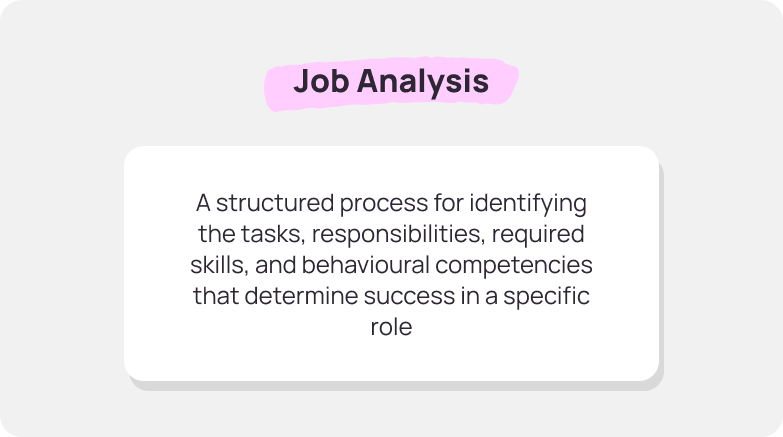
- A job analysis is a structured, systematic process for identifying the tasks, responsibilities, skills, and behavioural competencies that determine success in a specific role.
- A thorough job analysis produces the foundation for accurate job descriptions, structured interview questions, scoring rubrics, and fair shortlisting criteria.
- Without a job analysis method, hiring teams assess candidates against vague standards and make selection decisions based on instinct rather than evidence.
- AI tools like Sapia.ai‘s Job Analysis Studio (JAS) make it possible to complete a rigorous job analysis in minutes, removing the time barrier that causes teams to skip it.
You can trace most hiring problems back to poorly-written job descriptions that attract the wrong candidates and vague interview questions that don’t uncover necessary competencies.
What do these two issues have in common? You can solve them by simply defining what your open role requires—technical skills, personality traits, etc.—before the hiring process begins.
Job analysis is the key. Keep reading to learn what a job analysis is, what makes job analysis important, how to conduct a job analysis, and more. That way, you can improve the quality of your hiring decisions.
What is a job analysis?
A job analysis is a systematic process for identifying everything a role requires: the tasks performed, the job responsibilities involved, the technical skills required, and the behavioural competencies needed.
In other words, common job analysis methods answer a deceptively simple question: What does it take to do this specific job well? Generally speaking, a completed job analysis identifies:
- Core responsibilities: All the tasks the new employee must complete on a regular basis
- Required skills: The specific skills, mental abilities, and worker attributes the role demands
- Behavioural competencies: The traits that predict high performance in this particular job
- Performance standards: What success looks like at 90 days, six months, and one year
- Job context: The team dynamics, reporting structure, and working environment that the job entails
It’s important to understand the difference between a job analysis and a job description. A job analysis is the research process. A job description is an output of that process. Organisations that skip the analysis and write the description from scratch, or simply copy an existing job description from a previous hire, build on guesswork. To write accurate job descriptions, you need accurate information.
Job analysis also serves as the foundation for structured interviews, assessment rubrics, and defensible shortlisting criteria. Without it, those tools lack a legitimate basis for the decisions they support.
Why most hiring teams skip job analysis data, and what it costs
Job analysis takes time. Most hiring teams need to fill roles quickly, so they copy current job descriptions from previous hiring cycles, make a few edits, and move forward. It seems faster.
However, the downstream costs of skipping job analyses are significant:
- Interview questions that measure the wrong things: Without a thorough analysis of job requirements, interviewers default to generic questions, not questions that assess necessary skills.
- Inconsistent evaluation across interviewers: When hiring managers apply their own criteria, candidate assessments reflect individual preferences rather than job-relevant standards.
- Bias in selection decisions: Vague or undefined criteria give bias more room to operate. Every candidate is assessed against standards that were never explicit.
- Higher early attrition: When the role isn’t accurately represented or understood throughout the hiring process, both the organisation and the new hire pay the price.
Fifty years of research show that structured interviews built on job analysis predict job performance with greater accuracy. Yet, Human Resources professionals still have a problem: Job analysis has historically been slow, resource-intensive, and easy to deprioritise under hiring pressure.
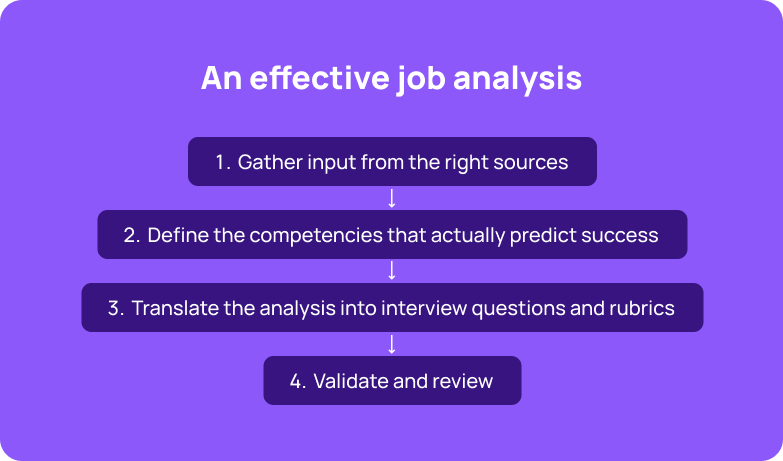
4 steps to conduct an effective job analysis
A thorough job analysis doesn’t need to take weeks, but it does need to follow a disciplined process.
1. Gather input from the right sources
An effective job analysis will draw on input from high performers: Those in the current role, peers, direct reports, and the hiring manager. Common job analysis methods for collecting data include:
- Structured interviews with multiple stakeholders
- Observation of the role in practice
- Review of performance appraisal data and existing criteria
- Analysis of what a current job description says versus what the role involves
The goal of this first step is to obtain reliable data about the role rather than one person’s assumptions about it. The latter won’t help you hire the right person or ensure proper job evaluation after recruitment.
2. Define the competencies that actually predict success
Your job analysis should identify the behavioural traits and skills that predict top performance in the specific role you’re hiring for. Don’t default to a generic list of desirable qualities.
Sapia.ai’s competency framework, derived from analysis of over 37,000 job descriptions globally, offers a validated starting point to identify the most relevant competencies for a given job position. Rather than starting from scratch, your hiring team can use it as a structured reference to determine a candidate’s knowledge, skills, and abilities. It can also assist performance management tasks in the future.
Then there’s Sapia.ai’s Job Analysis Studio (JAS), which converts job descriptions into competency-aligned interview questions and scoring rubrics. That said, our platform prioritizes the human review process, so your team never has to accept AI output without scrutiny and always maintains control.
3. Translate the analysis into interview questions and rubrics
Ideally, your job analysis helps shape hiring outcomes.
This can only happen if it connects directly to the candidate interview process. In other words, make sure the competencies you identify in the analysis inform the questions you ask and how you score responses.
At the end of the day, research proves that behavioural and situational questions derived from a job analysis produce higher validity than questions generated from an interviewer’s instinct. So, proper Human Resources management requires you to translate analysis into the right questions and rubrics.
4. Validate and review
Job analysis isn’t a one-time exercise. Roles evolve, and business priorities shift. The analysis you did three years ago may no longer reflect the current landscape or job characteristics.
Track hiring outcomes against the criteria used to select candidates. Do the people you assess on these competencies perform well and stay in their roles? If not, you need to update the criteria. Job analysis results should feed back into the process. They shouldn’t sit in a document that nobody revisits.
How AI is changing the job analysis process
The traditional approach to job analysis—conducting interviews, collecting data, mapping competencies, and developing structured assessments—can take weeks. This is why hiring teams skip it.
Sapia.ai’s Job Analysis Studio is the answer. Our platform analyses job descriptions, maps them to validated competency frameworks, and generates structured interview questions and scoring rubrics in minutes.
As mentioned above, Jas users don’t have to relinquish control of their process, though. JAS’s output is never applied automatically. Your hiring team will review and confirm competency weightings before you assess candidates, which keeps expert judgement at the centre of the hiring workflow.
All told, Jas makes thorough job analysis practical at scale, including for high-volume roles and organisations hiring across multiple business units at the same time. You can then pair this tool with our AI Smart Interviewer to ensure you choose candidates who match your company’s values and culture.
Job analysis as the foundation for fairer hiring
Rigorous job analysis impacts fairness in the recruitment and selection process.
When you define selection criteria before you assess candidates, and you tie the criteria to observable, job-relevant behaviours, the scope for bias gets narrower. Why? You base hiring decisions on the factors that connect to job requirements, not the person in front of you.
A documented job analysis also creates an audit trail. As regulators continue to scrutinise AI hiring practices, you need to prove that you base assessment decisions on defensible, job-related criteria. A thorough analysis will lead to an audit trail, which you can use to demonstrate compliance.
This connects to broader themes in Human Resource management, like building structured, evidence-based hiring processes that improve team culture and employee development. When you define job requirements from the outset, your definitions become the reference point for everything that follows.
Build a functional job analysis
Job analysis is more than a bureaucratic formality. It’s the foundation that determines whether the rest of your hiring process measures the right things. Organisations that do it well hire more consistently and fairly, and achieve better outcomes. Those who skip it rely on luck to hire the right people.
Want to see how Sapia.ai’s JAS automates and scales the job analysis process? Book a demo.
FAQs about conducting job analysis
A job analysis is the structured research process used to identify role requirements. A job description is a written output produced from said research, which clarifies details about an open role.
Common job analysis methods include structured stakeholder interviews, direct observation, the review of performance data, task inventory exercises, and the assessment of existing job descriptions.
Job analysis identifies the specific skills and competencies a role requires, giving interviewers a defensible, evidence-based framework for the questions they ask and how they score responses.
Review the job analysis when the role changes or your hiring outcomes suggest that your selection criteria no longer predict performance. Annual reviews are a reasonable baseline for most roles.
Tools like Sapia.ai’s JAS analyse job descriptions, map them to validated competency frameworks, and generate structured questions and rubrics on autopilot. That said, human review will always remain part of the process, so speed never comes at the expense of expert judgement.
If you define job-relevant criteria before you assess candidates, you remove the ambiguity that gives bias room to operate. As such, you make decisions against observable, pre-defined standards rather than subjective impressions formed during the interview itself. This reduces bias.
Proper job analysis identifies the competencies that predict success in a specific role. Then, a competency-based assessment uses those findings to structure the interview, design the questions, and create scoring rubrics that are grounded in real-world job duties and requirements.
About Author