How to build a talent mobility strategy that actually retains people


TL;DR
- A well-designed talent mobility strategy moves beyond reactive backfilling. It maps existing employee skills, creates visible career pathways, and applies consistent assessment.
- Replacing an employee with an external hire costs between 50% and 200% of their annual salary. Internal hires ramp faster, retain longer, and cost significantly less than external ones.
- Most internal mobility programmes fail because they lack data, consistent processes, and manager accountability, not because the idea is old-fashioned or flawed.
- AI-driven tools give HR leaders real-time workforce intelligence, surfacing flight risks, hidden internal candidates, and emerging skills gaps, so you can make better hiring decisions.
Your business is losing good people. The question is, why?
In all likelihood, it’s because your workforce is blind to the career development opportunities within your organisation. When career growth feels impossible, employees look for new ventures.
You could hire external talent to fill the gap, but it’s expensive, slow, and uncertain. Fortunately, the people your company needs are already inside your business, hiding in plain sight.
With that in mind, we want to offer you a talent mobility strategy guide. If you’re looking to move beyond ad hoc internal moves and build a deliberate, data-backed internal talent mobility plan, keep reading.
What’s a talent mobility strategy, and why does it matter now?
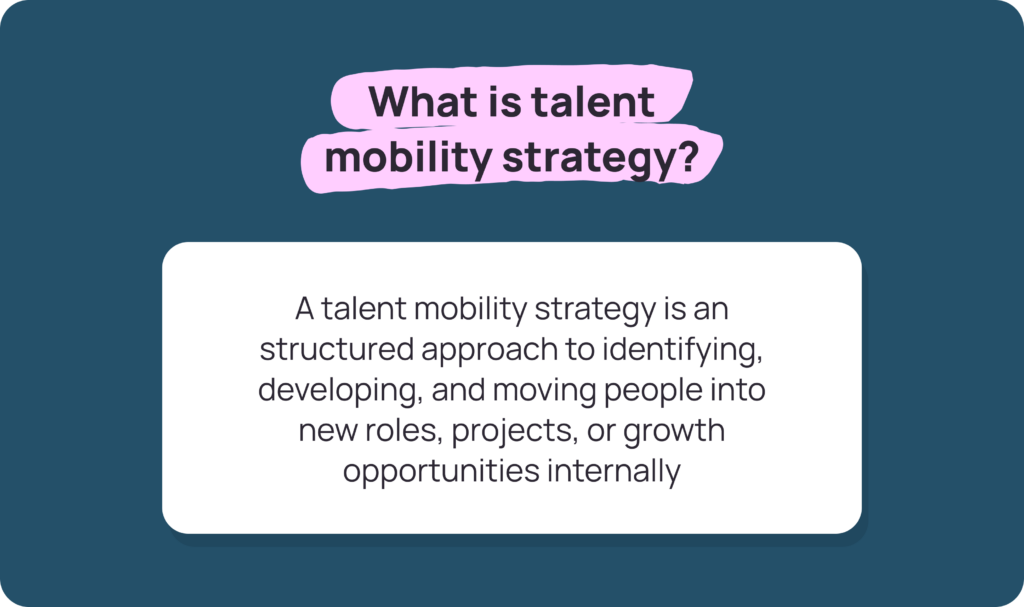
A talent mobility strategy is a structured approach to identifying, developing, and presenting your current employees with the chance to grow and progress within your organisation.
There are different types of talent mobility. For example, vertical mobility enables employees to earn promotions and work themselves up the corporate ladder. Cross-functional mobility, on the other hand, funnels employees into project-based roles and/or geographic moves to capitalise on global talent.
It’s important to understand the difference between reactive and proactive mobility. Reactive mobility fills vacancies when they open. Proactive mobility identifies employees with potential and funnels them into critical future leadership pipelines. Doing so closes skill gaps and creates career progression opportunities that keep people engaged, so they never even think about leaving.
At the end of the day, the right talent mobility framework will help you retain employees longer, help them ramp faster when they accept new roles within your company, and engage them deeply with your organisation. These benefits lead to financial gains. It costs 50% to 200% of a departing employee’s salary to replace them, on average. A structured talent mobility programme shrinks this number.
In addition, aligning mobility to broader business strategies, like workforce planning and organisational agility, turns talent management into a competitive advantage.
Why most internal talent mobility programmes fail
Most organisations have an internal jobs board. HR teams post openings there, but then forget the boards exist. Sound familiar? To be clear, this is NOT an effective talent mobility strategy.
Beyond neglect, there are other reasons why internal employee mobility fails:
- Managers hoard team members because releasing top talent feels like a personal loss. Worse, very few companies reward managers for developing employees who level up inside the organisation.
- HR has no visibility into employee skills and potential that exist outside of their job titles and tenure. You can’t promote current team members if you don’t know what they can do.
- Companies hold internal candidates to higher standards than external ones. As such, internal candidates face additional interviews and justifications that external applicants don’t.
- Organisations don’t use a structured assessment process to evaluate existing employees. Oftentimes, internal moves come down to who knows who, not who can do what.
The building blocks of an effective talent mobility strategy
Want to get talent mobility right? Build the right processes, access the right data, and invest in the right tools. Doing so will make internal movement visible, fair, and scalable for your company.

Mapping skills and potential across the organisation
You can’t move people into the right roles if you don’t know what they can do beyond their current job title. Good news: A competency framework will help you understand transferable skills, behavioural attributes, and development areas, enabling you to build rich employee profiles based on data.
When you learn what people can do now, not only what they did in the past, you surface talent that would otherwise stay hidden. A strong competency framework is the start.
Creating visible, accessible internal pathways
Your employees can’t pursue opportunities they can’t see. Transparent role requirements, clearly defined growth tracks, and career conversations grounded in data, not gut feel, help build a culture in which internal career growth feels possible. That feeling is often all it takes to retain talent.
Sapia.ai’s AI career coach, Phai, helps employees understand their own profile and explore internal fit before they apply for a role. As such, it reduces the friction between seeing an opportunity and pursuing it.
Applying consistent, fair assessment to internal candidates
Internal candidates deserve the same quality of assessment as external ones.
Applying structured assessment removes favouritism, gives every employee a fair shot regardless of their reporting line, and gives managers objective data to support decisions.
It also helps ensure strategic alignment between the talent you develop and the roles that matter most to your business. Sapia.ai’s internal mobility solution fills this purpose.
Building manager capability and accountability
Managers are the biggest enablers and blockers of internal mobility. If they’re incentivised to keep their best people, the programme won’t move. Your organisation needs to reframe how it measures manager performance. That way, it rewards managers who develop and release talent.
When managers have access to objective assessment data, it’s easier for them to make and defend internal hiring decisions. Dee Set is a good example of what high churn costs in practice, making it clear that supporting employee mobility should be a commercial priority, not only an HR one.
How AI makes your talent mobility strategy actionable at scale
Manual talent reviews and spreadsheet-based succession planning can’t keep pace with workforce change. This fact forces many organisations into reactive hiring practices.
AI-driven platforms change the narrative by surfacing insights that traditional processes can’t reach. For example, AI can help you answer questions like, “Which employees are flight risks?” and “Which internal candidates have the skills to fill open roles?” and “Where do skill gaps form?“
These are the questions that determine whether a talent mobility strategy delivers on business objectives. Answering them requires workforce intelligence with 24/7 operational capabilities.
Sapia.ai’s DiscoverInsights dashboard gives HR leaders real-time visibility across the talent funnel, so you gain deeper insight into your workforce on an ongoing basis. Then, our Talent Intelligence Agent (TIA) works alongside as an AI co-pilot, synthesising those insights into actionable recommendations.
For organisations that focus on employee engagement and the broader employee value proposition, this level of visibility enables HR to connect retention and development efforts in personalised ways.
Measuring whether your talent mobility efforts are working
If you want to build a resilient talent strategy, you must measure your efforts. Without clear metrics, it’s impossible to know whether your talent mobility functions deliver results or only generate activity.

- Internal mobility rate: This KPI measures the percentage of open roles filled internally over time. It’s your most direct signal of whether your strategic mobility programme works.
- Time to productivity: This KPI measures ramp-time for internal vs. external hires. Internal hires should ramp faster. If they don’t, something in your process needs attention.
- Retention rates: This KPI measures retention among internal and external hires. Since turnover costs are high, even a modest improvement generates meaningful ROI.
- Employee sentiment: This KPI reflects the employee experience within your organisation. It should improve when your workforce realises they have growth and development opportunities.
- Representation of underrepresented groups: This KPI compares representation for internal vs external recruits. It ensures your talent mobility framework is not only fair but accessible.
Build a more engaged workforce with a successful talent mobility strategy
A talent mobility strategy is one of the highest-ROI investments an HR leader can make.

The organisations that get this right will retain and develop talent, while their competitors spend a fortune to hire externally. Structured talent mobility programmes, backed by consistent assessment and real-time data, turn workforce planning from a reactive function into a genuine strategic capability.
Book a demo to see how Sapia.ai supports internal mobility for companies like yours.
FAQs about global talent mobility
A talent mobility strategy covers all structured internal movement, including lateral, cross-functional, and vertical moves. Succession planning focuses on filling specific senior roles. Put simply, talent mobility is broader, ongoing, and applies across the entire workforce.
Most internal mobility programmes fail because they lack data, consistency, and manager buy-in. Without objective assessment and clear incentives for managers to develop and release talent, mobility relies on informal networks. This workflow replicates bias and makes capable employees invisible.
Apply the same structured assessment process to internal and external candidates. Objective competency data removes favouritism and gives every employee an equal opportunity.
AI surfaces insights that manual reviews miss, such as flight-risk signals, hidden internal candidates, and emerging skills gaps. Tools like Sapia.ai’s DiscoverInsights and TIA give HR leaders real-time visibility. That way, they can act before problems become vacancies.
Reframe incentives so that your company rewards the development and release of talent. Then, equip managers with objective assessment data so internal hiring decisions feel evidence-based, not personal.
Track internal mobility rate, time to productivity for internal versus external hires, retention rates among internally mobile employees, employee sentiment on growth, and representation of underrepresented groups in internal moves and promotions. Compare your results to the same metrics for external hires.
Early signals, such as improved sentiment scores and reduced voluntary turnover in target cohorts, can appear within six to twelve months. Significant retention improvements typically take twelve to twenty-four months, as the programme reaches critical mass across the organisation.
About Author