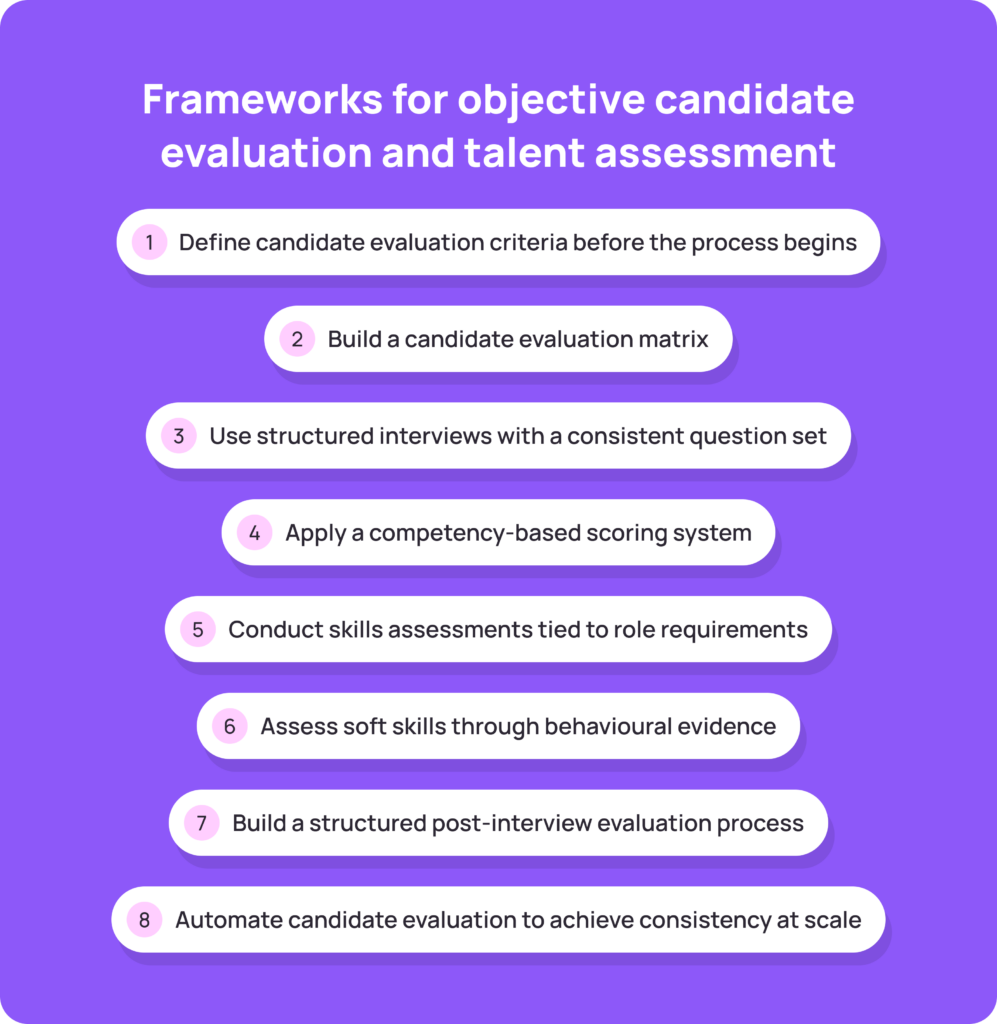
Frameworks for objective candidate evaluation and talent assessment


TL;DR
- Candidate evaluation is the structured process of assessing candidates against defined criteria to determine their suitability for a role.
- Subjective, unstructured evaluation is one of the leading causes of poor hiring decisions and a primary entry point for bias.
- The most reliable candidate evaluation frameworks combine clear criteria, consistent scoring systems, and structured interviews to produce comparable, defensible outcomes.
- Candidate evaluation automation is increasingly used to scale objective assessment without sacrificing quality or fairness.
- Sapia.ai brings together structured interviewing, competency-based scoring, and AI-powered candidate profiles to give hiring teams a complete, objective view of every candidate.
What is candidate evaluation?
Candidate evaluation is the process of systematically assessing candidates to determine how well they meet the requirements of a role. Done well, it gives hiring teams a structured, evidence-based way to compare candidates and make confident hiring decisions. Done poorly, it defaults to gut feel, inconsistent impressions, and the kind of subjective judgment that lets bias quietly shape who gets hired.
The difference between a rigourous candidate evaluation process and an informal one is not just a matter of compliance or fairness, though both matter. It is also a matter of quality. Research consistently shows that structured evaluation methods outperform unstructured approaches in predicting job performance. When every member of a hiring team assesses candidates using the same criteria, against the same scoring system, the result is a hiring decision grounded in evidence rather than impression.
This article sets out eight frameworks for conducting comprehensive candidate evaluation, covering what to assess, how to assess it, and how candidate evaluation automation can make the process faster, more consistent, and fairer at scale.
Why the evaluation of candidates so often falls short
Most organisations know that their candidate evaluation process could be better. The problems tend to be the same regardless of industry or company size. Hiring managers assess candidates differently from one another. Interview questions vary from session to session. Evaluation criteria exist on paper but are inconsistently applied in practice. And the person who gets the offer is sometimes the candidate who made the best first impression rather than the one best suited to the role.
These are not character flaws. They are the predictable result of a process that relies too heavily on individual judgment without enough structure to support it. Unstructured candidate interview evaluation is one of the weakest predictors of future job performance in the research literature, yet it remains common in organisations that have not yet built a more rigorous approach.
The cost of poor evaluation compounds quickly. A bad hire at a mid-level role can cost an organisation anywhere from half to twice that employee’s annual salary, once you account for lost productivity, onboarding costs, and the recruitment cycle that follows. Building a reliable evaluation process is not overhead. It is risk management.
Framework 1: Define candidate evaluation criteria before the process begins
Every other element of a good evaluation process depends on this one. Clear evaluation criteria, agreed upon before a single candidate is assessed, are what allow hiring teams to compare candidates consistently and make decisions that can be explained and defended.
Candidate evaluation criteria should reflect the actual requirements of the role, not a wishlist of credentials or a proxy for cultural fit. They typically cover a combination of technical skills specific to the role, behavioural competencies such as communication skills, problem-solving, and adaptability, and values alignment with the company’s culture. The relative weight of each category should also be defined upfront, so that all hiring team members are applying the same judgment when they evaluate candidates.
Sapia.ai‘s Job Analysis Studio converts job descriptions into competency-aligned interview questions and scoring rubrics automatically, so that the evaluation criteria are embedded into the assessment process rather than left as an afterthought. This is the foundation on which every other framework in this list depends.
Framework 2: Build a candidate evaluation matrix
A candidate evaluation matrix is a practical tool for applying defined criteria consistently across a candidate pool. It translates the evaluation criteria into a scoring system that every hiring team member uses in the same way, producing comparable data rather than a collection of individual impressions.
In its simplest form, a candidate evaluation matrix lists the competencies being assessed down one axis and the candidates across the other. Each competency is scored on a defined scale, typically 1 to 5, with clear anchors for what each score represents. A score of 1 on problem-solving approaches should mean something specific and consistent, not whatever individual interviewers happen to associate with the concept.
The matrix serves two purposes. First, it forces the hiring team to be explicit about what they are actually assessing, which reduces the scope for subjective impressions to drive decisions. Second, it makes it straightforward to compare candidates objectively at the end of the interview process, using data rather than memory of who seemed more impressive on the day.
Framework 3: Use structured interviews with a consistent question set
Structured interviews, where every candidate is asked the same set of questions in the same order and evaluated against the same rubric, are one of the strongest predictors of job performance available to hiring teams. The evidence for this is extensive and consistent across decades of research.
The reason structured interviews work is the same reason the candidate evaluation matrix works: consistency. When candidates answer different questions in different conversations, the hiring team is not comparing like with like. When every candidate responds to the same set of questions, their answers can be genuinely evaluated against each other and against the defined criteria.
Structured interview questions typically combine behavioural prompts, asking candidates how they have handled situations in the past, with situational prompts, asking how they would approach defined scenarios. Both formats produce evidence that is more predictive of future performance than general conversation or questions about a candidate’s career story.
Sapia.ai‘s Chat Interview conducts structured interviews at scale through a text-based, untimed, mobile-first experience. Every candidate answers the same set of questions, scored by validated AI models against competency frameworks, so that the candidate interview evaluation is consistent across thousands of applicants, not just the handful a recruiter has time to speak with personally.
Framework 4: Apply a competency-based scoring system
Competency-based evaluation is an approach to candidate assessment that focuses on the specific behaviours and capabilities required to perform well in a role, rather than on credentials, experience, or subjective impressions of potential. Each competency is defined clearly, and candidates are assessed against those definitions rather than against a reviewer’s general sense of how the conversation went.
For the scoring system to work, the anchors at each level of the scale need to be behavioural and specific. “Strong communicator” is not a useful anchor. “Candidate provided a clear, structured explanation of a complex situation, adapting their language appropriately to the audience” is. The more precisely the anchors are defined, the more reliably different assessors will reach the same conclusion when they evaluate candidates based on the same response.
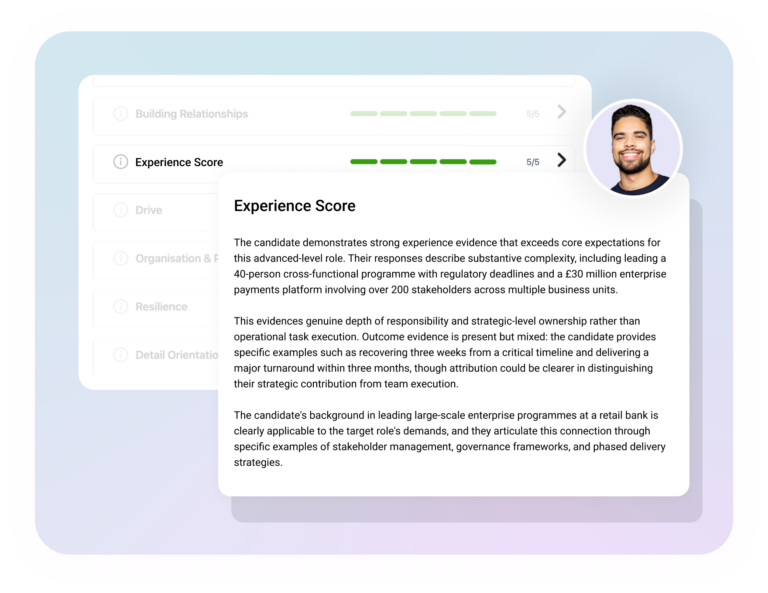
Sapia.ai‘s SAIGE scoring engine powers competency-based scoring across 25 competencies, with evaluation rubrics built into the scoring model. Recruiters receive a detailed Talent Insights profile for every candidate that shows their scores across personality traits, behavioural competencies, and communication skills, benchmarked against both the candidate pool and market norms – and full explanations for each score. Hiring managers get a clear, comparable view of every candidate without having to reconstruct it from interview notes.
Framework 5: Conduct skills assessments tied to role requirements
Technical skills assessments give hiring teams direct evidence of a candidate’s ability to perform the core tasks of a role, rather than relying on their account of past performance. For roles with clearly defined technical requirements, a well-designed skills assessment is one of the most reliable inputs into a comprehensive candidate evaluation.
The key is that skills assessments should be directly tied to job requirements rather than used as general intelligence tests or proxies for educational background. An assessment that requires candidates to demonstrate the specific technical skills a role demands is both more predictive and more defensible than one that tests abstract reasoning in ways that advantage certain educational backgrounds over others.
Skills assessments also improve candidate experience when they are clearly relevant and proportionate to the role. Candidates who can see the connection between the assessment and the job they are applying for tend to engage more seriously and leave with a more positive impression of the organisation, even if they are ultimately unsuccessful.
Framework 6: Assess soft skills through behavioural evidence
Soft skills are among the most important predictors of long-term job performance and team fit, and they are also among the hardest to assess reliably. Communication skills, adaptability, problem-solving, and collaboration are exactly the qualities that differentiate strong performers from average ones in most roles, yet they are often assessed through impression rather than evidence.
Behavioural interview questions, framed around specific past situations, generate the evidence needed to assess soft skills in a structured way. When a candidate describes how they navigated a conflict with a colleague, how they adapted their approach when a project changed direction, or how they communicated a difficult decision to a team, they are providing observable data that can be evaluated against defined criteria.
The challenge is that soft skills assessment tends to be where interviewer subjectivity has the most impact. Two interviewers observing the same answer can reach very different conclusions, particularly when the criteria are not defined clearly. This is where candidate evaluation automation adds genuine value. AI-powered assessment tools can evaluate soft skills through text-based interview responses at a level of consistency that human assessors cannot match at scale, without the variability introduced by different interviewers on different days.
Framework 7: Build a structured post-interview evaluation process
The candidate evaluation process does not end when the interview does. How a hiring team consolidates its assessments, compares candidates, and reaches a decision is just as important as what happens during the interview itself.
A structured evaluation process after the interview stage typically involves each hiring team member completing their scorecard independently before any group discussion takes place. This matters because group discussions, when they happen before individual scores are recorded, tend to anchor around the opinions of the most senior or most vocal person in the room, suppressing independent assessments and reducing the value of having multiple evaluators.
Once individual scores are recorded, the hiring team compares candidates against the defined criteria rather than against each other’s impressions. The question is not “who did we like best?” but “which candidate’s evidence across these criteria most closely matches what this role requires?” That shift in framing produces better decisions and a more transparent process that candidates progress through fairly.
Framework 8: Automate candidate evaluation to achieve consistency at scale
For organisations hiring at volume, a manual evaluation process introduces inconsistency by design. When different recruiters are screening hundreds of candidates, applying criteria slightly differently, and making shortlisting decisions based on varying interpretations of the same rubric, the variation compounds quickly. Candidate evaluation automation addresses this by applying the same criteria, the same scoring logic, and the same standards to every candidate in the pool.
AI-powered evaluation platforms go beyond simply automating administrative tasks. Platforms like Sapia.ai use validated AI to assess candidate responses against competency frameworks at scale, producing ranked shortlists, detailed Talent Insights profiles, and personalised follow-up interview questions for every candidate. The assessment is consistent, explainable, and tested for bias across demographic groups, so hiring teams can act on the results with confidence.
Candidate evaluation automation also improves the experience for candidates themselves. When every candidate receives a structured interview and a personalised insights report, the process feels fairer and more respectful regardless of outcome. For organisations whose candidates are also their customers, that is not a secondary consideration. It is a direct contributor to brand perception and customer loyalty.
The Sapia.ai platform brings all eight of these frameworks together in a single, integrated solution. From competency-aligned job analysis and structured Chat Interviews to AI-powered scoring, ranked shortlists, and Talent Insights profiles, it gives hiring teams the tools to conduct comprehensive candidate evaluation at any scale, without sacrificing the objectivity that good hiring decisions require.
Putting it all together: what a complete evaluation process looks like
A rigorous candidate evaluation process is not a collection of isolated tools. It is a coherent system in which every stage feeds into the next. Evaluation criteria defined upfront shape the interview questions. Structured interviews generate the evidence that scoring rubrics need. Post-interview scorecards preserve individual assessments before group discussion shapes the final decision.
When these elements work together, the result is a process that consistently surfaces the best candidates, reduces the influence of bias at every stage, and produces hiring decisions that hiring teams can stand behind. The organisations that build this kind of process do not just hire better people. They build a competitive advantage that compounds over time, because the quality of every team depends on the quality of the decisions made at the point of hiring.
For hiring teams ready to build that kind of process, Sapia.ai‘s competency framework resource is a practical starting point, and the broader talent assessment tools guide covers how to think about the technology choices that underpin a modern evaluation process. When you are ready to see it in action, book a demo.
Conclusion
Candidate evaluation done well is one of the highest-leverage investments a hiring team can make. The frameworks in this article, from clear criteria and competency-based scoring to structured interviews and candidate evaluation automation, each address a different way that evaluation processes typically fall short. Used together, they create a comprehensive candidate evaluation process that is fair, consistent, and genuinely predictive of who will perform well in the role.
The shift from subjective impression to structured evidence is not just about reducing bias, though that matters enormously. It is about making better decisions with greater confidence, at any volume, in any market.
Frequently asked questions about candidate evaluation
Candidate evaluation is the structured process of assessing candidates against defined criteria to determine their suitability for a role. It includes initial screening, skills assessments, structured interviews, and post-interview scoring, all applied consistently across the candidate pool.
The most important evaluation criteria are those directly tied to job requirements and performance. These typically include technical skills relevant to the role, behavioural competencies such as communication skills, problem-solving, and adaptability, and alignment with the company’s values. The relative weight of each criterion should be agreed upon before evaluation begins.
A candidate evaluation matrix is a scoring tool that allows hiring teams to assess candidates consistently against defined criteria. Each competency is scored on a defined scale, with clear behavioural anchors for each score level. The matrix makes it straightforward to compare candidates objectively after interviews are complete.
Candidate evaluation automation applies the same criteria and scoring logic to every candidate, eliminating the inconsistency that comes from different assessors interpreting the same rubric in different ways. AI-powered platforms can assess thousands of candidates at scale, produce ranked shortlists, and generate detailed competency profiles, all while maintaining the objectivity and fairness that manual processes struggle to achieve at volume.
Bias in candidate interview evaluation is reduced by defining evaluation criteria upfront, using structured interview questions that every candidate answers, applying a consistent scoring system with specific behavioural anchors, having evaluators complete scorecards independently before group discussion, and using AI-powered tools that assess candidates without reference to demographic data.
About Author