The hidden tax of reactive hiring: What it costs when a talent acquisition strategy can’t get ahead


TL;DR
- Most TA functions fight fires all day. As such, these teams lose three important things: strategic capacity, hiring quality, and credibility with leadership.
- Speeding up a broken process doesn’t fix underlying issues. Teams often “move faster” before they define what “good” looks like, which only produces wrong answers quickly.
- The foundation of a comprehensive talent acquisition strategy is clear success criteria, a standard job analysis, and structured interviews that predict performance.
- When job analysis is fast, consistent, and visible, TA stops being reactive and becomes a function that demonstrates fair, evidence-based hiring at scale.
The cycle nobody talks about
Tell us if this sounds familiar…
You gather your talent acquisition team before the next hiring cycle. Unfortunately, you’ve had to hire for this same role three times in the last year. Every time, the req is “urgent“. You move fast, fill the seat, and close the ticket. Then it opens again a few months later. Sigh…
Every TA leader knows this feeling. It’s not because their team is underperforming. It’s because the structure of their work makes it impossible to get ahead. Each req is another fire to put out. Each hire is already overdue. There’s no time to do the upfront work.
This is a structural problem, and the cost is higher than most organisations realise. After all, it doesn’t show up as a neat metric on a dashboard. It compounds quietly, in the form of backfills, declining standards, and a TA function that leadership stops trusting to find top talent.
This compounding cost is the “hidden tax of reactive hiring” for HR and hiring managers.
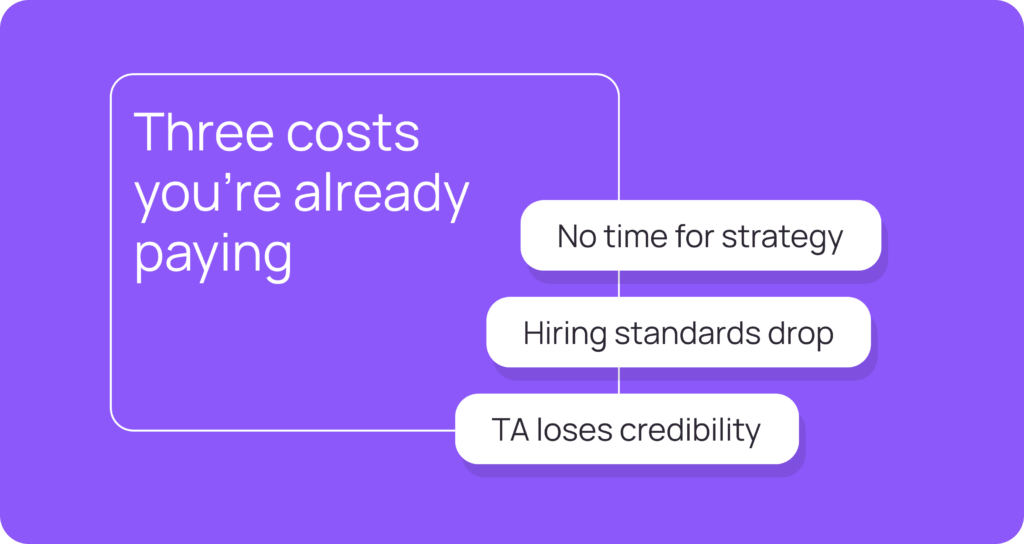
Three costs you are already paying
Want to build a successful talent acquisition strategy? You must avoid reactive hiring, which chips away at your strategic capacity, hiring standards, and credibility within the business.
You have no time for strategy
You can’t focus on workforce planning when your talent acquisition process runs on urgency.
Every hour goes to the job opening in front of you. There’s no time to look ahead, grow your talent pool, or build a talent acquisition strategy framework that serves future business needs.
The irony is that this is when strategic thinking is most needed. For talent acquisition leaders, proactive planning reduces backfills, and defined roles lead to more qualified candidates and less rework. But you can’t invest in the front end when the back end is always on fire.
Over time, this forces TA teams to operate below their potential. They push back the work that would make hiring more efficient in favour of work that needs to get done ASAP.
Hiring standards drop
The pressure to fill roles quickly doesn’t seem like a problem. It shows up gradually, in small compromises. You progress a candidate who doesn’t quite fit because the hiring manager needs someone now. You skip the structured hiring process because there’s no time to build it. You host interviews without agreed-upon success criteria, so decisions revert to gut feel.
None of these feels like a major failure. The req gets closed, and the seat gets filled. But the cost of a bad process accumulates. The new hire underperforms, so turnover goes up, and another backfill lands on your desk. It’s a vicious cycle, but a robust talent acquisition strategy can fix it.
TA loses credibility with the business
When senior leadership sees your talent acquisition efforts are always behind, reacting to problems instead of planning ahead, they think, “TA fills seats, but doesn’t shape strategy.“
This perception is damaging because it reduces TA’s authority in workforce planning conversations. It also makes it harder to justify investment in better tools or processes. These problems create anxiety for those leading talent acquisition because they’re not in control.
Why “hire faster” doesn’t fix it
How many times has your boss asked you to “find suitable candidates faster“? More times than you can count, right? Senior leadership thinks speed is the key to all current and future talent acquisition efforts. Reduce time to hire and streamline the recruitment process.
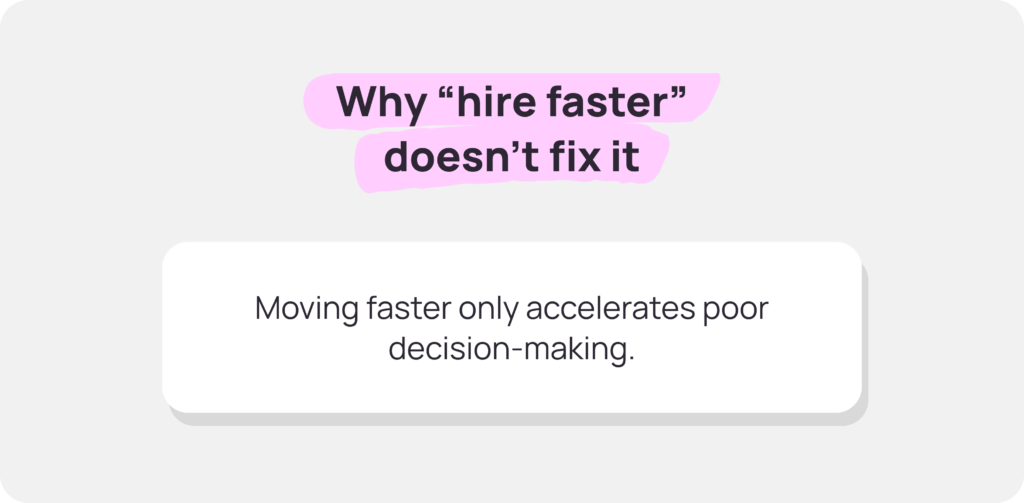
While speed isn’t a useless metric, it’s rarely the problem. More often, the underlying hiring process lacks rigour. Moving faster only accelerates poor decision-making. It leads to the wrong answer more quickly, which creates the conditions for another backfill sooner.
The real problem is that success was never defined. Job descriptions are recycled. Interviewers ask questions they deem important. There isn’t a standardized workflow to turn potential candidates into existing employees. Put simply, everyone on the TA team wings it, and it shows.
Without agreed-upon success criteria, all hiring decisions are subjective. And subjective decisions are hard to defend, hard to learn from, and hard to improve.
The research backs this up. Structured interviews, built from proper job analysis that leads to a strong job description, carry a validity coefficient of .42. Unstructured interviews, on the other hand, carry a validity coefficient of .20. Put simply, structured interviews in which you ask every candidate the same questions and grade every answer with the same scoring rubric are twice as predictive of future job performance than unstructured interviews.
Breaking the reactive cycle
To make the shift from reactive to strategic talent acquisition, prioritise the front-end work.
In other words, define what “good” looks like before you open your applicant tracking system, publish a job posting, or complete any other task to hire talent and achieve business success.
If you treat job analysis as an optional step in your recruitment strategy, it won’t get done. If you treat it as an essential element of your business strategy—at least when it comes to hiring employees—and streamline the process so that it’s easy to apply to every role, you’ll build a talent acquisition strategy framework that scales.
Remember the compounding effect we talked about earlier? When you know what to hire for and how to host competency-based interviews that surface the skills and qualities you desire, you’ll attract the best candidates. You’ll also retain talent better than your competitors.
When this happens, the backfills will disappear, your team will have time to breathe, and your talent leaders will be able to ask the question, “Is our talent acquisition strategy working?” Then they can make adjustments so the answer is a resounding “Yes!“
Shifting from “we filled the role” to “here is the chain of evidence from what we defined, to how we assessed, to how they performed,” separates strategic TA functions from reactive ones.
What this looks like in practice
Sapia.ai aims to streamline the recruitment process for high-volume brands in retail, contact centre, airline, RPO staffing, graduate hiring, and many other industries.
Our Job Analysis Studio offers a science-backed AI agent called Jas to help TA teams define the competency model for each role, which turns every job description into a weighted set of criteria that reflects the qualities that predict success. That model then drives a structured AI chat interview to assess all candidates consistently and at scale.
The result is a talent acquisition process where every decision is documented, assessments are tied to validated criteria, and the quality of hire conversation is diagnostic, not blame-driven. Teams can point to what they defined, how they measured it, and where to improve.
For present and future leaders who operate in the competitive talent market, this kind of evidence earns credibility within the business. Why? Because it demonstrates that you’ve grounded the hiring strategy in science, applied it consistently, and can produce positive outcomes.
Request a demo of Sapia.ai to see how our platform can level up your talent acquisition strategy.
FAQs about talent acquisition strategy
A talent acquisition strategy defines how your organisation will attract, assess, and hire the right talent to meet its business goals. A strong strategy does more than fill immediate job openings. It aligns hiring decisions with long-term workforce needs and uses consistent, evidence-based processes to improve quality of hire over time. It might also incorporate proven tools and tactics like talent acquisition software, job boards, employee referral programs, and ensuring a positive candidate experience for all job seekers, regardless of who they are or where they come from.
Recruitment typically refers to the process of filling a specific vacancy. Talent acquisition is broader. It includes workforce planning, employer brand, candidate experience, and pipeline building for future hiring needs. Strategic talent acquisition treats hiring as an ongoing function, not a response to an immediate demand. It’s proactive rather than reactive.
Here’s a proven talent acquisition strategy template: Identify what success looks like in each role. Define success criteria through job analysis before assessing candidates. Build structured interviews around those criteria, and gather insights to determine if your hiring decisions produce the outcomes you expect. Consistency and documentation make the strategy work.
Structure removes the variability that comes from gut-feel decision-making. When you evaluate every candidate against the same validated criteria, through the same process, the results are more predictive of actual job performance and easier to audit for fairness. Research shows structured interviews are more than twice as predictive as unstructured ones.
Look beyond time to hire. The most meaningful metrics connect hiring decisions to downstream outcomes, like quality of hire, retention rate, performance in role, and hiring manager satisfaction. When TA teams draw a clear line from what they defined, to how they assessed, to how new hires perform, they create the best talent acquisition strategy for their organization.
About Author