Most recruitment processes screen candidates on CVs first and interview later, which concentrates bias and wastes recruiter time on the wrong people.
Moving interviews to the start of the hiring process, using recruitment automation powered by AI tools and AI-powered software, means every candidate is assessed before a hiring manager reads a single resume.
Automating the interview stage cuts time to hire by up to 90%, reduces bias, improves quality of hire, and significantly improves candidate experience.
92% of HR leaders already use AI tools to automate tasks like resume screening and interview scheduling.
Structured, automated interviews are more predictive of job performance than unstructured manual ones and produce fairer outcomes across diverse candidate pools.
The highest return on investment comes from applying interview automation to high-volume roles first, then expanding from there.
We’ve relied on interviews for centuries. They are an important step in the selection process.
If done effectively, interviews are a great means of assessing a candidate. We trust them to enable us to determine if our candidates have the attributes, traits, behaviours, skills, experience and personality to meet the role requirements.
Here’s the problem with traditional methods and where AI interview platforms come in. It is physically impossible to interview every candidate manually. So, we rely on CV screening as the first step, a process often augmented by AI interview software. A recruiter on average spends six seconds looking at the resume. In those six seconds, a snap judgement is made on shortcuts (biases).
At the starting block, the process has already failed. You cannot possibly pick qualities like grit and initiative from a CV, right? Then, of the people who applied for the job, around 13% of applicants may get an AI job interview. During C-19 times – you can more than half that number.
With interview automation, interviews are at the start of your recruiting process – not midway through it.
In this way, you realise the value of interviews without investing one-minute of your time in them.
Imagine this. Everyone has already been interviewed before you have read one CV. A pre-qualified, pre-assessed, high-quality shortlist before you have read ONE CV. That’s the dream! Because now you are not wasting time reading resumes of people who either can’t do the job, won’t do the job, or they just don’t fit. And, instead of flicking through 100 resumes for a puny 6 seconds each, you can take the space to consider the best. The best? Those candidates who have already been pre-selected for that grit and initiative you so badly want in your team.
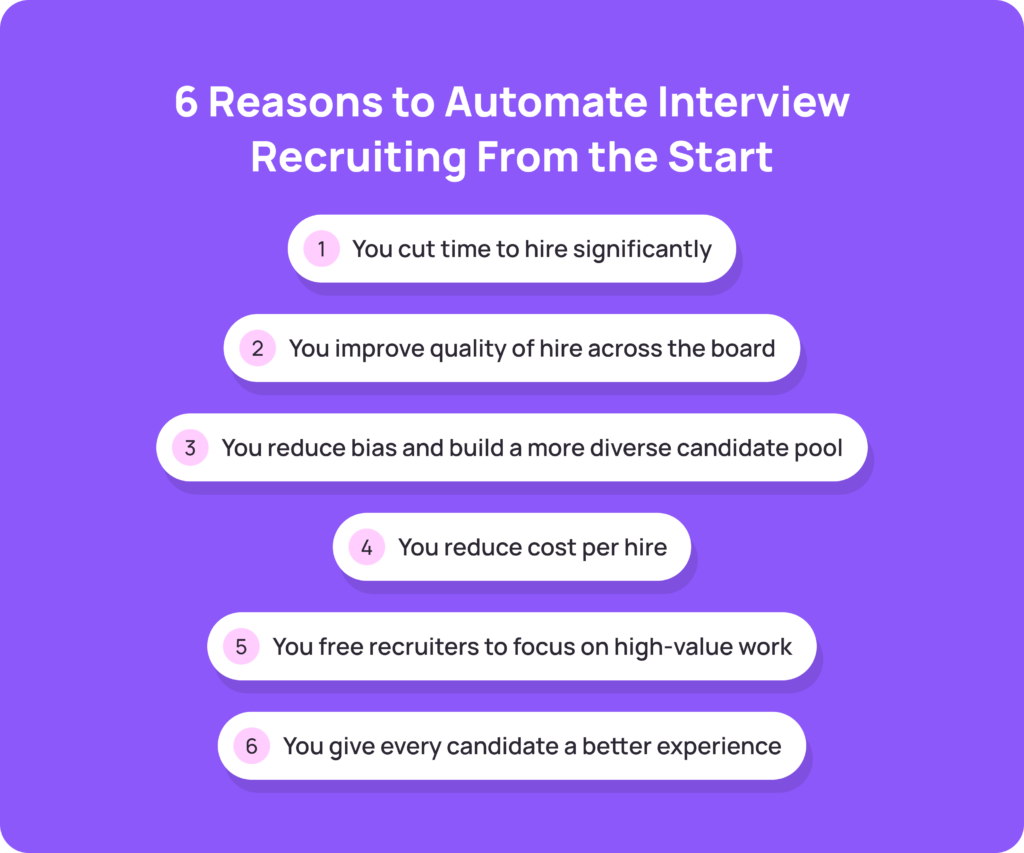
Okay, so here are the 6 reasons to start your recruiting process with interviews
Time to hire measures the number of days between first candidate contact and offer acceptance. CV screening is the first major bottleneck in that timeline. Even with an applicant tracking system that ranks resumes automatically, someone still has to review them. That review takes time, and the volume problem does not go away.
Automated interview recruiting removes that bottleneck. Every candidate completes a structured chat interview at the point of application. Recruiters receive a ranked shortlist in real time, scored against the role’s competency requirements, without reading a single resume first. AI-powered software can also automate the scheduling of interview slots by scanning recruiters’ calendars and suggesting optimal times based on candidate and interviewer availability. Sapia customers see screening times reduce by up to 90%.
Faster time to hire benefits everyone. Candidates get decisions sooner. Hiring managers get their teams to full strength faster. Recruiters hit their placement metrics without spending the majority of their week on manual tasks that automation handles better. 97% of organisations using automation report faster scheduling and fewer candidate drop-offs.
Interviewing automation makes your recruiting process much faster – usually around 90% faster.
2. You will improve the overall quality of hires
CVs tell you where someone has been. They do not tell you whether they have the drive, communication skills, or temperament to succeed in a role. Traits like initiative, resilience, and problem-solving do not appear on a resume, and they rarely surface in an unstructured interview conducted under time pressure.
Automated, structured interviews assess these attributes directly. Sapia’s AI analyses candidate responses for personality traits, communication skills, and work-based competencies, then ranks and grades every applicant against the job criteria and role requirements. AI-powered tools can quickly scan resumes for job criteria and transferable skills, not just explicit experience, helping to identify candidates who may be a strong fit even if their skills are not directly listed. Hiring managers receive complete candidate profiles before they make a decision.
Over time, the model learns what a successful hire looks like in your organisation and uses that learning to surface more candidates who match that profile. Predictive analytics and AI-powered candidate ranking tools use historical placement data to improve candidate matching and hiring speed. The result is a consistently higher-quality shortlist, not a larger one.
Interviewing automation gets you to the best of your talent pool much quicker resulting in, on aggregate, much better quality in your hires.
3. You will reduce bias and improve diversity
Human bias in hiring is well-documented and largely resistant to correction through training alone. Unconscious bias training does not change the structural conditions that produce biased decisions. A recruiter who genuinely believes they are objective can still default to pattern-matching on employer names, educational institutions, or demographic signals embedded in a resume.
Automated interview recruiting addresses bias at a structural level. Sapia’s chat interviews apply blind screening from the start: no CVs, no photos, no video, no demographic signals fed into the assessment. Every candidate answers the same structured questions and is scored against the same criteria. The model is tested continuously for adverse impact across gender and race groups, and results are monitored in real time through the Discover Insights dashboard. Structured workflows and automated compliance tracking ensure that every interview note, summary, scorecard, and decision rationale is logged correctly, reducing the risk of human error in recordkeeping.
Even when we don’t mean to be, human bias is pervasive. We keep these biases alive, through our relentless refusal to admit our shortfalls. And unfortunately, this isn’t great when it comes to hiring for diversity.
Ai is far less bias than humans.
This is how recruitment automation supports diversity hiring in practice: not through aspiration, but through a process that removes the inputs that produce biased outcomes. Automation also keeps hiring managers and recruiters on the same page with automated summaries and notifications, improving alignment and reducing unnecessary meetings.
Interviewing automation makes your recruiting process much fairer and your hiring decisions far more diverse.
4. You will reduce the cost of each hire
Those who have already automated their interviews have reallocated that spend toward higher-value investments.
The cost of a bad hire extends well beyond the recruitment process itself. When an employee leaves within their first year, the organisation absorbs advertising costs, screening time, lost productivity, and the full cost of repeating the process. Australian HR Institute research found an average annual turnover rate of 18% across industry sectors, rising to 37% among employees aged 18 to 35. As hiring volume increases, manual processes quickly become unsustainable, making automation essential to efficiently manage recruitment at scale without overburdening staff or sacrificing quality.
The real game-changer is that interview automation can also help you solve a churn problem.
Significant costs are borne by an organisation when an employee voluntarily leaves.
Automated interview recruiting reduces cost per hire in two ways. First, it cuts the hours recruiters spend on manual screening tasks, freeing that time for higher-value work. Workflow triggers can automate routine recruitment tasks such as task assignment, status updates, and candidate communications, further reducing manual effort and minimising human error. Second, it improves the predictive accuracy of hiring decisions, which reduces the frequency of early attrition. Candidates assessed on job-relevant traits rather than credentials are more likely to be a genuine fit and, in turn, more likely to stay.
If your recruitment automation tools are not yet covering the interview stage, that is where the highest return on investment is available. Automating the hiring process can cut hiring costs by up to 71% and save recruiters an average of 4.5 hours per week.
If you haven’t yet automated your interviews, you are spending too much on hiring.
5. You will increase the productivity of every recruiter
What’s the toughest part of your job as a Recruiter? If you had more time, could you do that part better?
Resume screening and first-round interviewing are the most time-consuming parts of recruiting, but they are rarely the parts where recruiter skill makes the biggest difference. The highest-value work is relationship building, stakeholder management, understanding what hiring managers actually need, and building talent pipelines for hard-to-fill roles.
Automated workflows that handle the initial screening and interview scheduling return that time to recruiters. AI assistants can now manage initial candidate screening, take interview notes, and support candidate debriefing, further streamlining the process. AI-powered sourcing tools automate candidate sourcing and candidate outreach by searching databases, social media, and job boards to identify both active and passive candidates, ensuring a wider and more effective talent pool. Instead of spending the majority of the week on repetitive tasks, recruiters can focus on candidate engagement, business partnering, and the judgment calls that genuinely require a human in the loop.
We cannot discuss productivity without also giving mention to structured interviews.
There is a secondary benefit here. Automation also helps recruiters track candidates and manage follow-ups, saving hours each week by sending confirmations, reminders, and nudges at the right time. Structured automated interviews are more predictive of job performance than unstructured manual ones. Research published by IEEE and referenced in Sapia’s own work shows that structured interviews, where every candidate answers the same questions, evaluated against a consistent rubric, both reduce bias and improve the accuracy of hiring decisions. Recruiter time is better spent on candidates who have already been assessed this way.
Interviewing automation frees up recruiter’s time to perform higher-value tasks with far greater output.
6. You will boost candidate experience (beyond imagination)
Most candidate experience problems trace back to the same root cause: candidates apply, hear nothing for weeks, and either receive a generic rejection or disappear into silence. This damages employer brand and reduces the quality of future talent pools.
According to the Society for Human Resource Management (SHRM), 82% of candidates report the ideal recruiter interaction is a mix of innovative technology and personal, human interaction.
If your mission is to provide the best experience possible to your candidates, interview automation should not be ignored.
Interview automation changes this from the first touchpoint. Every candidate gets a structured, mobile-first chat interview they can complete anywhere, at any time, in their own language. There is no time pressure. There is no video to record. There is no confrontational format to navigate. Following the interview, every candidate receives a personalised MyInsights report with feedback on their traits and coaching tips for their career, regardless of whether they progress.
Here is what interview automation offers above a manual interview process for candidates:
Utterly relatable – An accessible, mobile-first ‘familiar’ text experience that candidates enjoy with no confronting videos or questionnaires. Questions are related directly to role attributes.
Totally convenient – Completing it anywhere, anytime and in your own time with an untimed interview – giving candidates the space to be themselves.
Wholeheartedly fair – Everyone gets an interview levelling the playing field for all. It’s blind screening at its best – no gender, age or ethnicity revealed.
Unbelievably motivating – Following their FirstInterview all candidates receive an email with personalised insights. It’s delightfully surprising to receive something of such great value.
Surprisingly beneficial – Candidates receive coaching tips that help them with their career, transforming the experience.
Highly open – Candidate experience improves by 148% when candidates are asked for interview feedback. That’s why after their FirstInterview all candidates can rate their experience and give their input.
Interviewing automation enhances candidate experience, with no further time investment from you.
Taking the first step on automating your interviews: start with volume roles first.
Gartner predicts by 2021, 50% of enterprises will spend greater budget on chatbot creation and bots than traditional mobile app development.
Businesses are adopting Sapia’s chat interviews across various job families – especially in front-line customer service roles. The quickest payback you will get on an investment in interview automation is to apply it to your high-volume roles first. Interview automation can truly enhance your high-volume recruitment process and help you make it more efficient (and pleasant) for everyone involved. This will help you get your time-back really quickly and release the budget for automation in other areas of recruiting.
The future of all first interactions between candidates and your business will be through automation. The only decision, for now, is where you will adopt interview automation first.
Join the movement
To keep up to date on all things “Hiring with Ai” subscribe to our blog!
Frequently asked questions about automating interview recruiting
What is recruitment process automation in the context of interviews?
Recruitment process automation refers to using AI-powered software and AI tools to handle tasks in the hiring process that would otherwise require manual effort. For interviews, this means every candidate receives a structured, AI-scored interview at the point of application, with results ranked and delivered to hiring managers in real time, without any recruiter involvement in the initial screening stage. AI-powered software streamlines tasks such as resume screening, candidate sourcing, and interview scheduling, improving efficiency and quality throughout the process.
Does automating interviews mean removing the human from hiring?
No. Automated interview recruiting handles the first stage of assessment so that recruiters and hiring managers spend their time on qualified candidates who have already been assessed against the role criteria. Human judgment remains central to hiring decisions. Automation removes the manual tasks that sit upstream of those decisions, including resume screening, scheduling, and first-round interview administration.
How does automated interview scheduling work?
Automated scheduling tools allow candidates to self-select interview times from available slots, send automated reminders, and update applicant tracking systems without manual data entry. Sapia’s live interview scheduling uses natural language input, so recruiters can type availability in plain language (for example, “Monday 9 to 12”) and the system generates and sends time slots to candidates automatically. Automated reporting tools continuously track key recruitment metrics such as pass-through rates, time to fill, funnel health, active pipeline volume, and conversion bottlenecks without requiring manual updates.
Is recruitment automation only suitable for high-volume hiring?
High-volume hiring produces the fastest return on investment, which is why it is the recommended starting point. However, structured automated interviews are equally applicable to professional and specialist roles. The SAIGE scoring engine used in Sapia’s Chat Pro product is specifically designed for skilled roles, assessing candidates across a competency framework of 25 competencies with detailed reasoning attached to each score.
How does interview automation affect candidate experience?
Positively and measurably. Candidates receive a structured, untimed, mobile-first interview they can complete on their own schedule. Every candidate gets personalised feedback after completing the interview, regardless of whether they progress. Sapia’s average candidate happiness score is 9 out of 10, and completion rates average 75.4%. These numbers improve when candidates are also asked to rate their experience at the end of the process, which Sapia collects by default. Automated reminders for expiring certifications or upcoming start dates help maintain compliance and keep candidates informed throughout the process.
Can automated interviews reduce bias in the recruitment process?
Yes, when designed correctly. Sapia’s chat interviews remove demographic signals including name, gender, age, and appearance from the initial screening process. Candidates are assessed on their text responses to structured questions, scored against role-relevant competencies. The model is tested at every stage of development for adverse impact across gender and race groups using the 4/5ths rule and effect size analysis. Results are monitored continuously through the Discover Insights dashboard.
What should I look for in recruitment automation software?
Look for software that integrates with your existing applicant tracking system, supports structured interviews with consistent scoring rubrics, provides candidate-level explainability, and reports on diversity outcomes across the hiring funnel. Bias testing methodology should be documented and available on request. The candidate experience should be mobile-first, accessible, and designed to maximise candidate engagement rather than screen people out on format. Automated compliance tracking ensures that every interview note, summary, scorecard, and decision rationale is logged correctly, reducing the risk of human error in recordkeeping. Automation also helps manage sensitive data and strict documentation requirements more effectively.
To provide the best experiences, we use technologies like cookies to store and/or access device information. Consenting to these technologies will allow us to process data such as browsing behaviour or unique IDs on this site. Not consenting or withdrawing consent, may adversely affect certain features and functions.
Functional
Always active
The technical storage or access is strictly necessary for the legitimate purpose of enabling the use of a specific service explicitly requested by the subscriber or user, or for the sole purpose of carrying out the transmission of a communication over an electronic communications network.
Preferences
The technical storage or access is necessary for the legitimate purpose of storing preferences that are not requested by the subscriber or user.
Statistics
The technical storage or access that is used exclusively for statistical purposes.The technical storage or access that is used exclusively for anonymous statistical purposes. Without a subpoena, voluntary compliance on the part of your Internet Service Provider, or additional records from a third party, information stored or retrieved for this purpose alone cannot usually be used to identify you.
Marketing
The technical storage or access is required to create user profiles to send advertising, or to track the user on a website or across several websites for similar marketing purposes.
To provide the best experiences, we use technologies like cookies to store and/or access device information. Consenting to these technologies will allow us to process data such as browsing behaviour or unique IDs on this site. Not consenting or withdrawing consent, may adversely affect certain features and functions.
Functional
Always active
The technical storage or access is strictly necessary for the legitimate purpose of enabling the use of a specific service explicitly requested by the subscriber or user, or for the sole purpose of carrying out the transmission of a communication over an electronic communications network.
Preferences
The technical storage or access is necessary for the legitimate purpose of storing preferences that are not requested by the subscriber or user.
Statistics
The technical storage or access that is used exclusively for statistical purposes.The technical storage or access that is used exclusively for anonymous statistical purposes. Without a subpoena, voluntary compliance on the part of your Internet Service Provider, or additional records from a third party, information stored or retrieved for this purpose alone cannot usually be used to identify you.
Marketing
The technical storage or access is required to create user profiles to send advertising, or to track the user on a website or across several websites for similar marketing purposes.